The air-source heat pump vs built-in hot tub heater decision depends on your tub, usage and installed economics. For a hot tub used regularly through the year, an air-source heat pump can be worth investigating if the tub maker approves the exact integration and the installed economics add up. For an occasional-use spa, keeping the built-in electric heater is usually the simpler choice. The biggest mistake is buying a heat pump on a headline efficiency figure before checking the spa’s controller, circulation circuit and real heating pattern.
In This Article
- Air-source heat pump vs built-in hot tub heater: how each works
- Compare efficiency in real UK conditions
- Compare heating speed and recovery
- Calculate an illustrative running-cost comparison
- Account for purchase, installation and space
- Check your tub and controller for compatibility
- Choose by usage pattern and climate
- The verdict: when to keep or upgrade
- Frequently Asked Questions
Air-source heat pump vs built-in hot tub heater: how each works
Built-in resistance heating
Most hot tubs already have an electric resistance heater in the water circuit. Electricity passes through an element and the resulting heat is transferred into circulating water. For a simple energy calculation, one kilowatt-hour of electricity becomes roughly one kilowatt-hour of heat at the element. The exact time taken to warm a tub also depends on water volume, starting temperature, heat losses, pump operation and the controller’s rules about heating while jets run.
The virtue of this arrangement is integration. The manufacturer has matched the heater, sensors, flow monitoring and control logic to the spa. It occupies no extra outdoor floor space and usually works across the operating range specified for the tub. You still need to keep the cover sound and the water circuit maintained: an electric element cannot overcome heavy heat loss without running longer. The guide to heating a hot tub faster covers those heat-retention basics.
The built-in heater remains a strong reference choice. It can make good sense when the tub is used occasionally, the electricity bill is modest, the site has little room for an outdoor unit or the maker does not permit an add-on heat pump. Keep a properly working heater unless a specific upgrade case beats the whole installed cost and complexity.
Air-source heat-pump heating
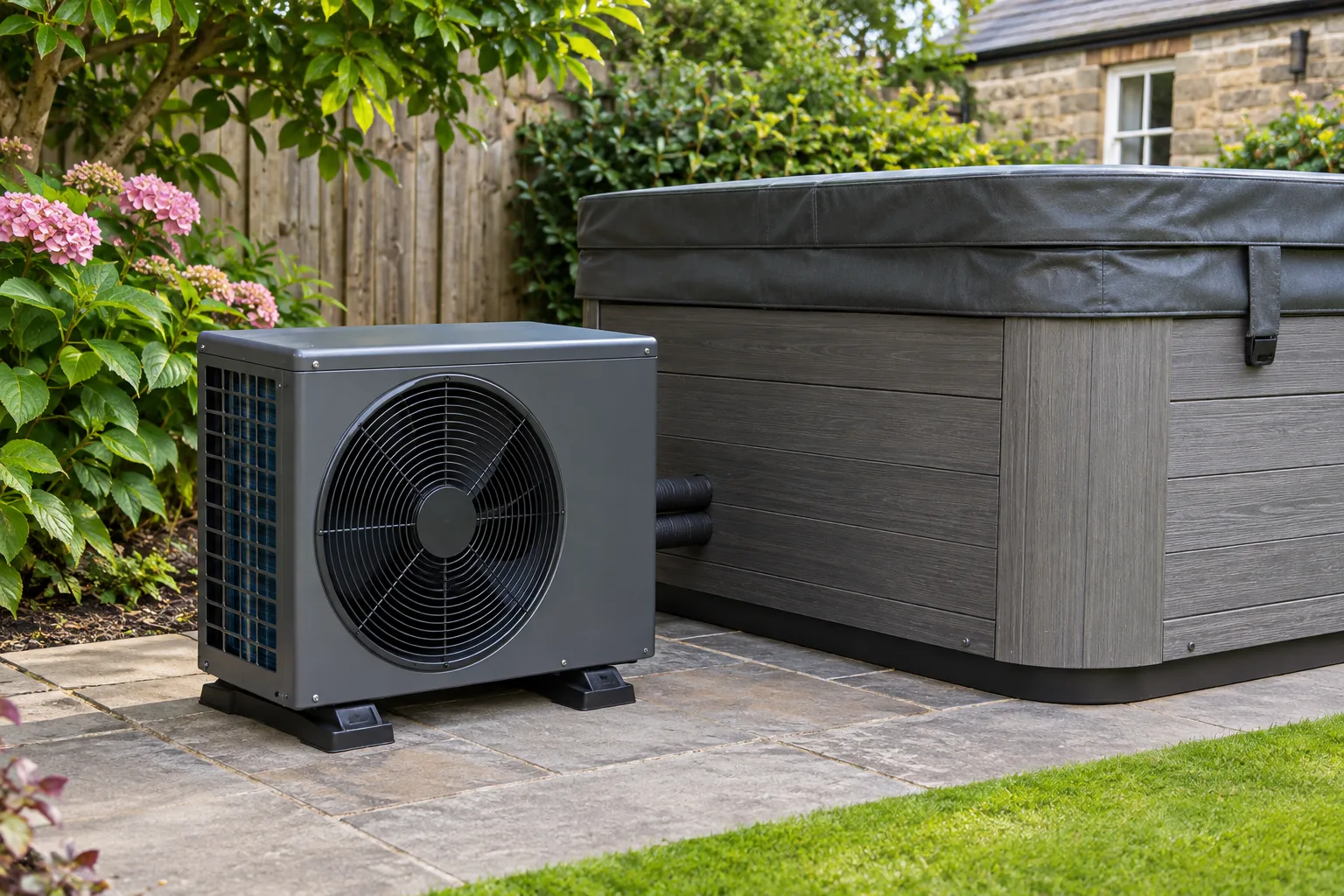
A heat pump uses electricity to move heat from outside air into a refrigerant circuit, then transfers that heat to the spa water. That can deliver more heat to the water than the electricity consumed by the compressor under suitable conditions. The ratio is called the coefficient of performance, or COP: a COP of 3 means an illustrative 3 kWh of heat transferred for 1 kWh of electrical input at the stated test condition. It is a measured operating point, not a year-round bill reduction promise.
Spa-specific equipment matters. A domestic air-source heat pump built for house heating needs separate approval before use with a hot tub. Spa water chemistry, flow, target temperature and controller integration create a different application. Balboa’s Clim8zone product information describes a heat-pump system designed to work with specified Balboa control systems. Even within that family, “most BP series” is not a guarantee for every tub, firmware revision or panel. The installer must confirm the exact combination.
Compare efficiency in real UK conditions
Why the test figure changes outdoors
A heat pump gathers heat from air, so outside temperature influences available heat and electrical efficiency. The target water temperature, compressor speed and defrost operation can also change performance. A mild day with a covered spa is a different test from a cold, windy January evening with the lid open. Compare the maker’s published conditions and ask the installer for performance information relevant to your intended use, not just the best figure on a sales card.
Balboa’s Clim8zone mode guide makes the trade-off unusually clear: its high-output mode prioritises heating capacity with lower COP, while its lower-output mode increases efficiency at the expense of speed. That is specific to its named equipment, but the principle helps explain why “efficient” and “fastest” are different questions. An owner who wants rapid weekend warm-up may operate differently from someone who keeps the tub hot all week.
Heat loss can dwarf clever equipment choices. A waterlogged cover, uncovered waiting time, exposed cabinet or cold refill increases the heat needed from either system. Read the hot tub energy-ratings explanation alongside any heat-pump quote. Improving the cover and insulation may be the cheaper first step, especially when the existing heater works normally.
Consider the whole system’s electricity
The compressor is only part of a heat-pump installation. Water must circulate through the appropriate path, and controls, pumps or fans consume electricity. Some systems call on the existing resistance heater under particular conditions. Ask the supplier which figures include those loads and when backup heat may run. An attractive COP measured for the unit alone cannot be multiplied directly into a whole-spa bill saving.
The tub’s own daily use is the best baseline. Use a suitable energy monitor or an electrician-installed circuit measurement and record a week of stable operation with the cover and set temperature you actually use. Our hot tub electricity-usage guide explains how to think in kWh. A winter and a mild-weather sample are better than one unusual evening.
Compare heating speed and recovery
Separate heat output from heat-up time
A product may show greater rated heat output than the tub’s built-in element, yet the real time to reach bathing temperature still depends on its output under the day’s air and water conditions. Some heat pumps vary compressor speed; others may pause to defrost. The water circuit and controller can also limit when the unit runs. Ask for a realistic heat-up estimate for your tub volume, starting water temperature and local winter conditions, with assumptions shown.
The first fill needs far more energy than a small overnight top-up. Heating 1,000 litres of water by 20°C takes roughly 23 kWh of heat before losses: 1,000 kg × 4.186 kJ/kg°C × 20°C ÷ 3,600. A nominal 2 kW heater would need about 11.6 hours to deliver that energy if it ran continuously and losses were zero; real time will be longer. A heat pump’s rated thermal output may shorten a first fill in suitable weather, but a cold-air performance curve is essential before claiming that it will.
For a covered tub held at temperature, the daily task is replacing heat lost to the environment and use. A heat pump can take longer to deliver a given increment in a quiet, high-efficiency mode and still use less electricity. If you need the spa warm at a precise hour, the controller’s schedule and backup-heater behaviour are just as important as the nameplate capacity.
Look at recovery after use
Leaving the lid open and running jets can lose heat quickly. A system that is efficient during slow maintenance may recover more slowly in cold air than a built-in heater or combined mode. Ask whether the proposed controls can use the existing element for faster recovery and how that changes electricity use. A promise that one technology is always faster is too broad for a UK garden across all seasons.
If your current tub struggles to recover, inspect the cover, filter flow and existing heater before pricing an upgrade. A fault should be diagnosed on its own merits; adding a second heating system is an expensive way to mask a worn cover or flow problem. The common hot tub problems guide offers a sensible diagnostic route.
Calculate an illustrative running-cost comparison
Use heat demand, not a savings slogan
Start with the measured electricity used for heating under a representative pattern. If your monitor captures the whole tub, separate or estimate pump and control loads carefully; otherwise keep the calculation as a scenario, not a forecast. Suppose a tub needs 30 kWh of heat over a chosen period. An electric resistance element would use about 30 kWh for that delivered heat. A hypothetical heat pump averaging COP 3 at the same water conditions would use about 10 kWh for the heat transfer, before any extra circulation, defrost or backup-heater energy.
At an illustrative unit rate of £0.25/kWh, those figures would be £7.50 and £2.50 for the heat-transfer portion of that period. The £5 difference is an example of the arithmetic, not a saving claim for a named tub. If the real seasonal COP is lower, heat demand changes, or extra pumps and installation costs are included, the outcome changes. Substitute your own tariff and measured use. Standing charge is normally already paid for the household connection, so comparing incremental kWh is the cleaner first pass.
| Input | Built-in resistance example | Heat-pump example | What to replace with your data |
|---|---|---|---|
| Heat delivered to water | 30 kWh | 30 kWh | Measured or carefully estimated demand |
| Heating efficiency assumption | About 1 kWh heat per kWh input | Seasonal COP 3, assumed | Installer’s model-specific seasonal evidence |
| Electricity for heat transfer | About 30 kWh | About 10 kWh | Add auxiliary and backup energy |
| Illustrative energy cost at £0.25/kWh | £7.50 | £2.50 | Your current unit rate and usage |
Test a realistic payback range
Obtain an itemised installed quote covering:
- Equipment: the exact heat pump and approved integration parts.
- Professional work: electrical supply, water-circuit changes and commissioning.
- Ownership: warranty, maintenance and service responsibility.
Then divide that net installed cost by a cautious annual operating saving based on your own consumption. If the project costs £2,000 and a defensible annual net saving is £200, the simple arithmetic is ten years before maintenance or future repairs. A £100 annual saving makes it twenty years. Those numbers illustrate sensitivity; neither is a prediction or a current UK quote.
Think about how long you intend to keep the tub, the equipment warranty and who will service the new unit. A quote that relies on a brochure COP in ideal air conditions may make the payback look unrealistically short. Ask for a low, central and high electricity-use scenario. The decision becomes clearer when the optimistic result and the cautious result are both visible.
Account for purchase, installation and space
Price the whole job
The heat-pump unit is only one line. A proper proposal should state the exact model, its electrical supply, approved plumbing arrangement, controller interface, required space, condensate drainage, commissioning and warranty responsibility. Include any extra circulation demand and whether the existing heater stays available. A cheap unit requiring an awkward retrofit can be dearer than a more expensive package designed for the spa.
Electrical and plumbing changes belong with suitably qualified professionals and the spa manufacturer’s approval. Hot tubs combine water, electricity and outdoor exposure. The UK hot tub electrical-requirements guide explains why the supply deserves a professional assessment. Ask the installer to state which professional is responsible for each part of the work and what certification or commissioning record you receive. This is a procurement checklist, not a DIY installation guide.
Leave room for air and people
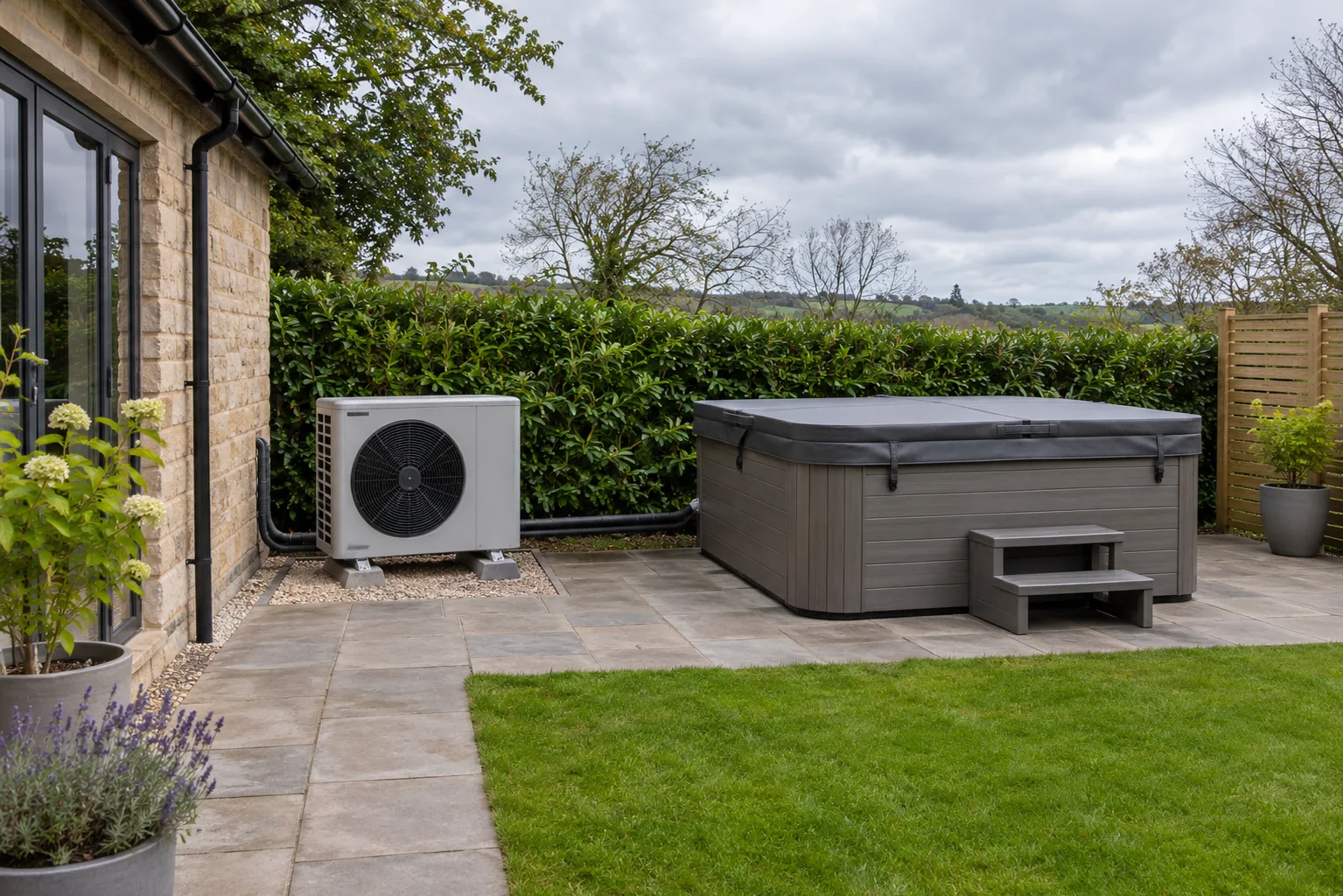
An outdoor heat pump needs the clearances specified by its maker to move air and allow service access. A tight enclosure or blocked outlet can undermine performance and make noise more noticeable. Consider its location relative to seating, a bedroom window, a neighbour’s boundary and the route for water and power. The hum of a fan matters most on a quiet evening when the hot tub itself is idle.
The unit may produce condensate and needs a suitable path for it. Its physical footprint is additional to the hot tub and any access needed around the cabinet. Check the proposed position against the hot tub installation-planning guide, then ask the installer to confirm the unit’s exact clearance and drainage requirements for your site. Do not build an attractive box around it before seeing those specifications.
Check your tub and controller for compatibility
The model-specific suitability checklist
A heat pump should be proposed against the actual spa, not against a generic “works with hot tubs” claim. Ask the spa manufacturer or authorised dealer to confirm the exact model, year, serial range, controller hardware and software, panel, circulation pump and warranty position. The installer should identify the approved heat-pump model and any interface kit. Verify who owns the final system commissioning and subsequent support.
- Maker permission: Does the hot-tub maker permit this specific heat-pump connection for your serial number?
- Controls: Can the installed controller and panel command the pump safely, and what firmware or interface is needed?
- Water circuit: Are flow rate, fittings, materials and operating temperature suitable for the spa’s treated water?
- Electrical supply: Does a qualified electrician confirm the supply and protection for the complete system?
- Site: Is there room for airflow, drainage, service access and an acceptable noise position?
- Warranty: What happens to the spa and heat-pump warranties if an approved installer performs the work?
Balboa describes its Clim8zone range as integrating with specified BP controllers and panels. That is useful evidence for a named system, not proof that every tub containing a Balboa-branded component is ready for the same retrofit. A control pack can be from one maker while the spa manufacturer’s plumbing, warranty and software differ. Get written confirmation for the assembled tub.
Treat uncertain interfaces as a stop sign
A supplier may offer an independent thermostat and plumbing bypass when direct integration is unavailable. That could alter the tub’s own flow, heating controls or fault detection. Without explicit maker approval and a professional design, do not assume an improvised bypass is equivalent to a supported kit. If the controller cannot safely coordinate the systems, keeping the existing heater is the stronger choice.
Inspect the installer quote for clear exclusions. If the maker will neither confirm compatibility nor stand behind the altered system, that uncertainty is part of the cost. A well-supported existing heater often wins over a theoretical bill saving attached to an unsupported retrofit.
Choose by usage pattern and climate
Year-round, frequently used tub
A spa held at bathing temperature most days creates repeated heat demand. This is the strongest case to investigate a heat pump, especially with a good cover, measured electricity use and a supported controller. There is enough operating time for improved efficiency to matter. The installed price still needs to earn its place, and cold-weather performance needs its own line in the assessment.
If the tub is large, well insulated and used through winter, ask for model-specific seasonal performance rather than a single summer COP. The heat-pump’s output in cold air and its defrost behaviour may influence the balance between quiet efficient maintenance and quick recovery. Retaining the built-in heater as a maker-approved backup may be valuable, but its use belongs in the running-cost estimate.
Occasional or seasonal tub
A weekend-only or summer-only spa may consume much less annual heating energy than a year-round one. A large percentage saving on a small bill can still be a small amount of money. The extra unit, installation and service needs can outweigh that benefit. For these owners, a sound insulated cover and a sensible heat-up schedule often deliver the more practical improvement.
An inflatable plug-and-play spa needs particular caution. Its pump housing, modest electrical supply and manufacturer warranty may leave no approved route for an external heat pump. Check the exact model before considering any add-on. Avoid using a generic domestic or pool heat pump as a shortcut to a hot-tub solution.
Cold-weather speed is your priority
If your main complaint is a slow first heat-up on a freezing weekend, a heat pump is not automatically the answer. Compare the proposed unit’s thermal output at the relevant ambient air temperature with the existing heater’s output and the tub’s heat loss. A well-fitting cover, wind shelter and working circulation can matter more. The high-efficiency mode may be slower, while a faster or combined mode may use more electricity. Buy for the measured problem rather than a generic efficiency headline.
The verdict: when to keep or upgrade
Keep the built-in heater when your hot tub is used occasionally, its running cost is acceptable, space is constrained or the maker cannot confirm a supported installation. It is already integrated and avoids an extra outdoor machine. Repair a faulty heater or leaking cover on its own merits before shopping for a heat-pump upgrade.
Investigate an air-source heat pump when you use a suitable tub regularly, have a measured energy baseline, can obtain written model-specific compatibility and receive a complete professional quote. Compare cautious annual savings with the whole installed price and your expected ownership period. The upgrade can make sense, but only for the real tub and real use pattern in front of you.
The mistake to avoid is equating a brochure COP with a guaranteed reduction in the whole hot-tub electricity bill. Air temperature, water target, heat losses, pumps, backup heat and control strategy all affect the outcome. Start with your actual kWh, get the exact manufacturer approval, and make the installer show their assumptions. That gives you a decision you can defend when the first winter bill arrives.
Frequently Asked Questions
Is a heat pump always cheaper to run than a built-in hot tub heater? A suitable heat pump can use less electricity for a given heat transfer under favourable conditions, but whole-system cost depends on weather, pumps, backup heat and usage.
Will a heat pump warm my hot tub faster in winter? Heating speed depends on the specific unit’s output in cold air, tub volume, cover losses and controls. A headline summer rating cannot establish winter heat-up time.
Can I attach any air-source heat pump to my spa? No. Ask the spa manufacturer and a qualified installer to confirm the exact controller, water circuit, electrical supply and warranty position.
Does a heat pump replace the built-in heater? Some approved systems retain the electric element for backup or faster recovery. The arrangement depends on the named spa and heat-pump controls.
How do I estimate whether an upgrade will pay back? Use measured hot-tub electricity, a cautious model-specific seasonal efficiency estimate and a complete installed quote. Compare several plausible annual-saving scenarios.
Is a domestic home-heating heat pump suitable for a hot tub? Treat house-heating equipment as a different application. Choose only a system explicitly approved for the specific spa and professionally designed for its water and controls.