Hot tub filter size and compatibility start with the specific tub and filter housing. A replacement cartridge needs to match that exact system, not just the white cylinder in your hand. Start with the spa model and original part number; then check the cartridge dimensions, end fittings and filtration specification. An approximate visual match is a poor basis for ordering a part that affects water flow.
In This Article
- Start with the tub identity, not the old cartridge
- Read the original part number and approved substitutes
- Measure the cartridge and both end fittings
- Check filtration and flow specifications
- Check hot tub filter size and compatibility
- Confirm compatibility before ordering
- Replace safely and verify the result
- Choose the right next action for common mismatches
- Frequently Asked Questions
Start with the tub identity, not the old cartridge
Find the exact model and revision
Write down the brand, model name, serial number and approximate manufacture date from the data plate or ownership paperwork. The model name alone can be too broad: makers sometimes change filter housings or circulation layouts during a product’s life. A serial number or build range lets the manufacturer or dealer check the right parts list. If the identification plate is difficult to reach, consult the owner’s manual before moving panels or putting a hand near equipment.
Inflatable and rigid spas use very different cartridge arrangements. Some inflatable units fit a small cartridge into a housing near the pump; many rigid tubs use a larger pleated element beneath a skimmer or inside a dedicated canister. Even among tubs from one brand, connection details vary. Lay-Z-Spa’s spare-parts catalogue provides a compatibility filter for this reason. Use the model and relevant pump version when searching its parts, rather than assuming every cartridge with a familiar type label will fit every Lay-Z-Spa.
Make a starting record before shopping:
- Tub identity: full model, serial number and manual edition.
- Filter arrangement: number of installed cartridges and the housing style.
- Existing part: any code on a previous genuine filter, photographed separately.
Photograph each item separately. This takes a few minutes and is more reliable than relying on a shop photograph viewed on a phone. If the old cartridge came with a second-hand spa, treat its code as a clue until the tub maker confirms it was the correct part in the first place.
Understand what the manual controls
The manual or official parts diagram should identify the filter type and the safe removal procedure. It may also specify the cartridge count, insertion direction, support cage, gasket or locking method. A replacement that seems to slide into the chamber can still leave a gap at the seal. Water can then bypass the media, or the cartridge can move when the pump starts.
Keep a copy of the correct page with your filter measurements. If a manual lists a part number but a retailer lists several alternatives, ask the manufacturer or its dealer which substitutions are approved for your exact serial range. For wider upkeep, the hot tub water-care schedule covers routine tasks; this guide concentrates on replacement fit.
Read the original part number and approved substitutes
Use the code as the primary search key
A printed OEM part number is usually the strongest short route to a replacement. Check the cartridge end cap, packaging, manual and maker’s online parts listing. Copy every letter, digit and suffix. Similar codes can denote different end caps or lengths. A supplier’s cross-reference is useful when it states the original code it replaces and gives clear fit details. A bare claim such as “fits most spas” is weak evidence.
The Canadian Spa filter range illustrates why brand alone is insufficient: it includes different formats such as slip-fit and low-profile cartridges, along with sets for other spa types. Its own guidance describes filters designed around particular flow, media area and end-cap specifications. This supports a model-led choice, although the exact product page and your spa documentation should still agree before purchase.
If the old cartridge has no readable code, move to the manufacturer parts list using the spa identity. A photo of the entire housing, including its retaining arrangement, helps a dealer distinguish between lookalikes. Never substitute a part solely because a marketplace title repeats your spa brand. Retail listings can include broad compatibility claims, copied measurements or mixed customer reviews across variants.
Make cross-references traceable
Third-party filter makers often use their own codes as well as OEM equivalents. Write both down with the source of the claim. A defensible cross-reference names your exact OEM part and gives matching outer diameter, overall length, end-cap geometry and any thread detail. If the product is sold as a two-cartridge set, check whether the listing’s dimensions describe one cartridge or the assembled pair.
Sometimes an OEM revises a filter and the new genuine cartridge looks different. In that case, the official supersession notice or dealer confirmation matters more than a visual comparison with the retired part. Conversely, a generic filter that looks identical may omit a gasket or have a different central opening. Do the paper check before the physical check; both need to agree.
Measure the cartridge and both end fittings
Take the dimensions that actually locate the part
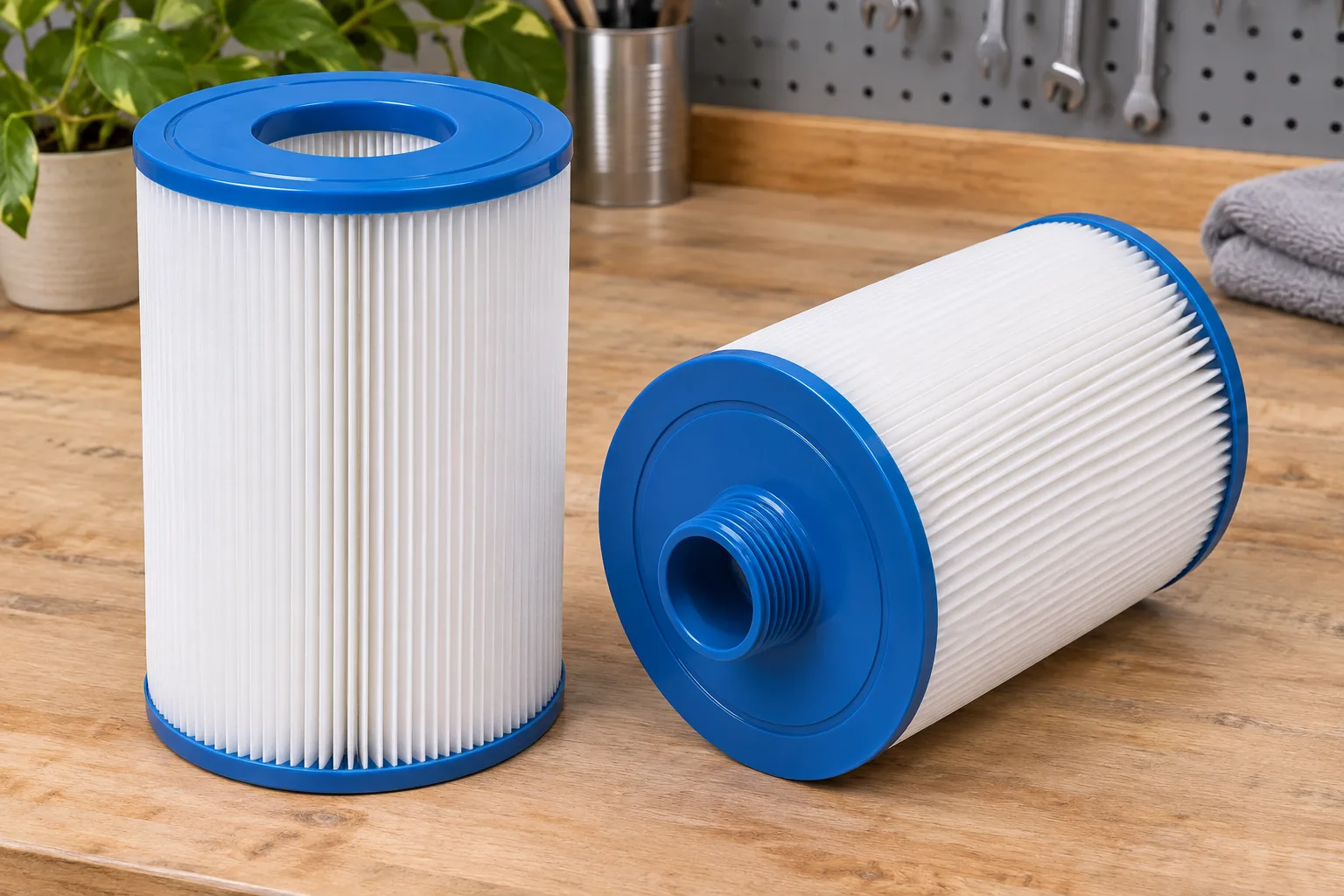
Measure the old cartridge only after following the maker’s power-off and removal instructions. Use a ruler or callipers and record dimensions in millimetres: maximum outside diameter, overall length including any projecting handle or thread, media-body length, and the diameter of each opening. Note whether the top is open, closed or fitted with a handle. Record whether the bottom is open, has a locating spigot, carries a coarse thread or uses a fine threaded fitting.
A millimetre difference is not automatically a failure because manufacturers round published measurements and used cartridges can deform. Yet the fitting must seat and seal as designed. Thread diameter alone is especially misleading: pitch, direction and cap shape also matter. Do not force a replacement into the housing to “make it work”; a cross-threaded fitting can damage the filter mount. If you cannot establish the thread type, use the part number and maker confirmation rather than guesswork.
For a rigid spa, photograph both ends against a plain background and include a ruler in one image. Take another photo of the empty filter chamber from a safe position. This gives a supplier enough context to identify a closed-top handle, open centre, support cage or locking collar. For an inflatable tub, check whether its cartridge sits inside a removable housing and whether the compatible housing version changed with pump generation.
Distinguish nominal from measured sizes
A shop may describe a cartridge as “20 cm” while its detailed specification gives a different length excluding the handle. Compare like with like. The top of a handle to the bottom of a thread is a different measurement from pleated-media length. When a listing omits the measurement method, ask before ordering. Filtration surface area, often quoted in square feet, is a media specification rather than a body dimension. It tells you little about whether the end cap physically fits.
Keep all measurements alongside the model and part code. A ruler photo is useful supporting evidence, but it cannot prove compatibility by itself. The filter-cleaning guide explains when an existing cartridge can be cleaned; use a replacement when the maker’s interval or physical condition calls for it.
Check filtration and flow specifications
Why similar cylinders can perform differently
A cartridge must do more than occupy the right space. The intended pleated-media area, core design and permitted flow need to suit the tub’s circulation system. A cartridge with a smaller effective media area may clog sooner or create higher resistance. A cartridge with poorly seated end caps can let water bypass the media. The original specification gives the benchmark; a compatible substitute should document how it meets that benchmark.
Published square-foot ratings are nominal and can reflect different pleat arrangements. That one number cannot establish equivalent flow or filtration. Likewise, a bigger rating may be a poor upgrade if the cartridge cannot seat in the housing or changes the circulation path. Do not remove a support cage, cut an end cap or leave a retaining ring loose to accommodate an appealing “higher capacity” filter.
Water chemistry still matters after a good filter choice. Filtration removes suspended material; sanitiser and balanced water handle different jobs. The chemicals for beginners guide explains that separate water-care decision. If you have persistent low-flow errors despite a verified clean cartridge, check the common hot tub problems guide and arrange professional help as appropriate.
Read specifications with the tub in mind
Record the original cartridge’s stated filtration area, filtration type and any flow-related instruction in the owner’s manual. A maker may distinguish standard pleated cartridges from proprietary or in-line systems. Treat antimicrobial media as a feature of a specific approved cartridge, rather than a reason to bypass a fit check. A premium-sounding material offers no benefit if the wrong part constricts circulation.
If the tub uses two cartridges, replace and compare them according to the maker’s instructions. Some systems use different elements in the same chamber; others use two matching parts. Check the manual to establish which arrangement you own. Photograph both old cartridges and retain each code until the new set has been confirmed.
Check hot tub filter size and compatibility
A written comparison catches mismatches that a product image hides. Use the table as an order checklist, not as a universal cartridge size chart. A blank or uncertain cell means the purchase still needs confirmation from the maker or an authorised dealer.
| Check | Original tub or part | Proposed replacement | Decision |
|---|---|---|---|
| Brand, model and serial range | Copy from plate and manual | Exact stated compatible range | Ask maker if broad or absent |
| OEM code and supersession | Manual or genuine cartridge code | Same code or documented equivalent | Trace the cross-reference |
| Outer diameter and overall length | Measure and note method | Compare like-for-like dimensions | Investigate any discrepancy |
| Top and bottom end fittings | Photo, openings, handle, thread | Exact matching geometry | Reject a different fitting |
| Media and flow specification | Maker’s stated requirement | Published equivalent specification | Confirm with maker if unclear |
| Quantity and housing version | Count and identify each position | Correct number and variant | Check full set before ordering |
What counts as enough evidence
The strongest match is a current genuine replacement listed for your exact model or OEM number, supported by a clear parts diagram. A named third-party equivalent can also be reasonable when its cross-reference and physical specification are complete and the tub maker permits it. The weakest match is a generic listing that shares only the diameter and marketing phrase “universal spa filter”.
Keep screenshots or order details of the exact variant. Retail pages can group several sizes under one product family, and a basket may default to a different option from the page you examined. Check the variant label at checkout. If you are buying a spare set, match every cartridge in the set rather than assuming the second item mirrors the first.
Confirm compatibility before ordering
Ask a question the supplier can actually answer
Send the manufacturer or authorised dealer a compact evidence pack:
- Identification: spa model, serial number and current OEM filter code.
- Fit: photos of both end caps, housing and your measured dimensions.
- Question: request the current approved part for that exact serial range.
Ask: “Which current filter part number is approved for this serial range, and does it replace the code printed on my existing cartridge?” This is much more useful than “Will this filter fit my hot tub?” A precise answer lets you compare the ordered item against the approved replacement.
Ask about a superseded code if the old part has disappeared from official stock. A dealer may confirm a revised cap or a new housing insert; retain that answer with the receipt. If a seller cannot explain a conflicting measurement or thread type, choose a better-documented source. A low price does not compensate for a part you cannot safely seat and verify.
Check the source and the returns terms
A genuine maker channel is the least ambiguous route when fit is complicated, although a correctly documented equivalent may be available elsewhere. Buy from a UK source that identifies the exact variant and offers ordinary returns for an unopened part. Check whether the cartridge is sold singly or as a set. A listing photo can show two filters while the selected option supplies one.
Consider timing. If you need the tub for the weekend, it is tempting to order from a blurry photo. A wrong filter can leave the spa unusable for longer, particularly when a seal or thread is damaged. Take the extra identification step before paying. For a pump or circulation fault, filter replacement may be irrelevant; the pump guide covers a separate equipment decision.
Replace safely and verify the result
Follow the maker’s shutdown sequence
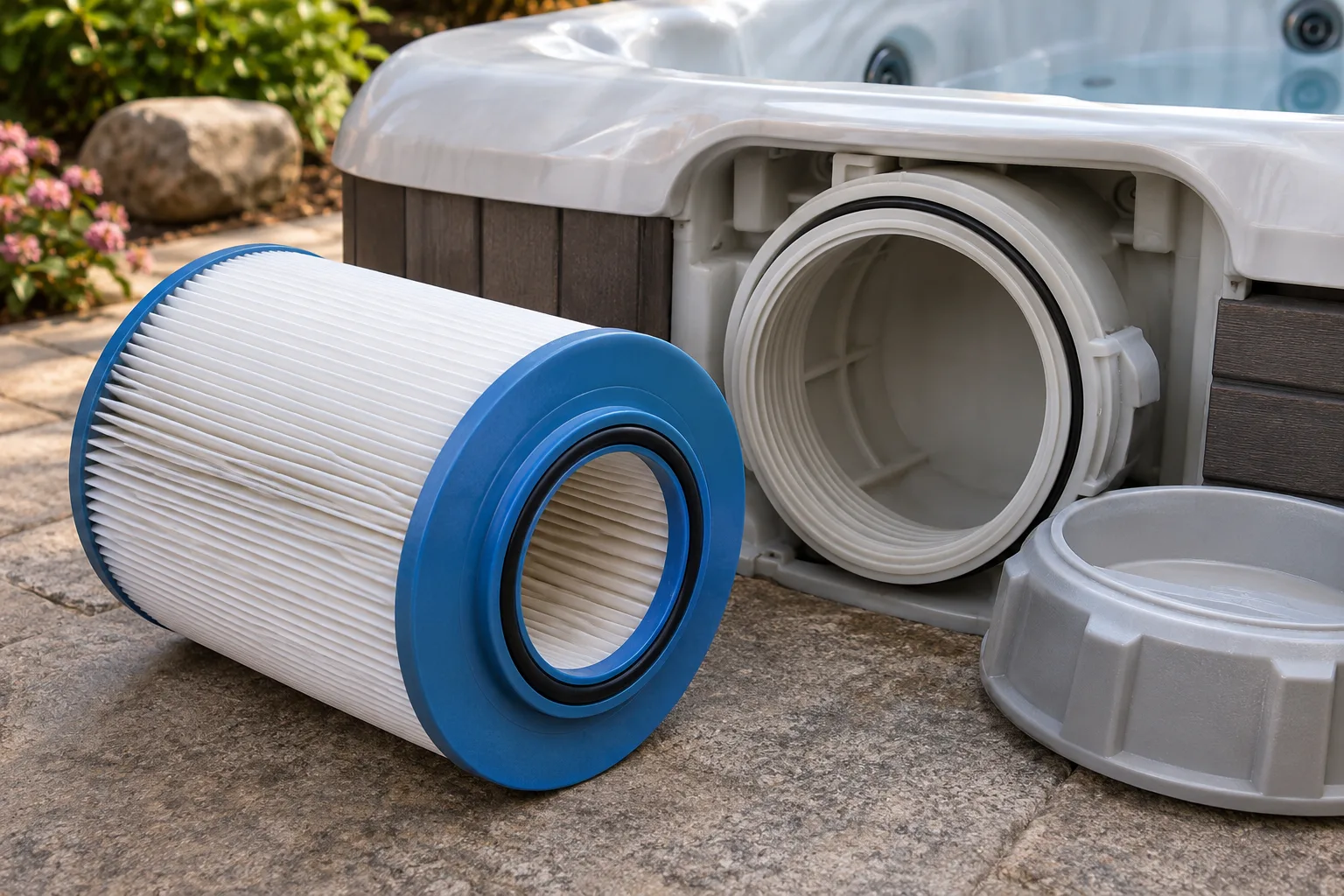
Switch off and isolate the tub as its manual directs before opening the filter housing. Some systems have automatic circulation cycles or stored settings that make a casual pause button insufficient. Keep hands clear of suction openings and electrical equipment. Never run a pump with an empty filter housing unless the maker explicitly instructs a service procedure. If reaching the cartridge requires removing an equipment panel or touching wiring, stop and use a qualified service professional.
Remove the old cartridge in the documented direction and inspect the housing for a displaced gasket, broken support or debris. Follow the manual for any cleaning or draining needed around the housing. This article does not replace the maker’s detailed maintenance procedure; it is a compatibility decision guide. Seat the approved new part without force, refit its retainer and close the housing exactly as shown by the maker.
Observe the first circulation cycle
Restore power only after the housing is secure. Check for leaks, unusual noises and any flow warning on the control panel. Verify that water circulates normally and that the cartridge remains seated. A quick visual confirmation now is worth more than discovering a loose fitting after the tub has been left unattended. If the system alarms or circulation appears weak, switch it off under the maker’s instructions and investigate the fit or seek service advice.
Keep the original part code and confirmed replacement number in your maintenance record. On the next purchase, you will have a verified starting point rather than another guessing exercise. Continue the cleaning and replacement schedule in the manual; replace a damaged or heavily worn cartridge according to that model-specific guidance.
Choose the right next action for common mismatches
No readable label or second-hand tub
Use the tub’s data plate and serial number first. Photograph the housing and old cartridge, then contact the maker or dealer. A second-hand seller may have fitted an incorrect substitute, so its existing cartridge is weaker evidence than the model’s official parts record. If the housing itself has been modified, ask a service technician to identify the complete assembly.
Dimensions match but the end cap differs
Stop the purchase. A different opening, cap lip or thread can prevent a proper seal even when the media cylinder is the same diameter. Obtain the exact end-fitting code or manufacturer-approved supersession. Filing plastic or swapping a gasket from a different cartridge is a poor solution for an uncertain fit.
Correct code, but a flow problem remains
Check that the exact ordered variant and quantity arrived, then follow the manual’s installation and priming advice. A flow error can also come from an air lock, blocked intake, pump fault or control issue. Avoid assuming the new filter is defective or that a larger nominal area will solve it. The common problems guide gives a wider diagnostic starting point.
Two cartridges or a specialist system
Map each position separately. A cartridge sold as part of a pair may have a mate with a different core or connection. Verify both codes and confirm whether the maker requires replacement as a set. For ceramic, in-line or proprietary systems, follow the specific manufacturer parts list rather than a generic pleated-cartridge chart.
The bottom line is simple: model and part-code confirmation come first; measurements and fitting details check the match; filtration specification completes it. If any layer disagrees, resolve it before ordering. That sequence protects your water circulation and saves the hassle of a plausible-looking filter that does not belong in the tub.
Frequently Asked Questions
Can I choose a hot tub filter by its dimensions alone? No. Dimensions help reject mismatches, but the model, original part number, end fittings and circulation specification must also agree.
Where is the hot tub filter part number? Check the owner’s manual, original packaging and cartridge end cap. If it is unreadable, use the spa model and serial number with the maker’s parts service.
Does the same square-foot rating mean two cartridges are interchangeable? No. Media-area ratings do not establish a matching thread, seal, core or approved flow specification.
What if my old cartridge code has been discontinued? Ask the manufacturer or authorised dealer for the current approved superseding part for your exact model and serial range.
Should I switch off the hot tub before changing its filter? Follow the maker’s full power-off and isolation instructions before opening the housing; some tubs can start circulation automatically.
Why does my new filter trigger a low-flow warning? An incorrect fit is one possibility, but trapped air, a blocked intake or a pump fault can also reduce flow. Switch off as directed and check the manual or a technician.