You’ve found the perfect spot for your hot tub — right on the back deck, steps from the patio doors, cold drink in hand by 7pm. Then someone mentions the weight. You’ve already worked out where to place your hot tub, and the deck seemed perfect. A filled hot tub with four adults in it can weigh well over 2,000 kg. Your deck was built for garden furniture and a barbecue, not a small car. So can it actually handle it, or are you looking at a very expensive and very wet disaster? For related guidance, see our Hot Tub Chemicals for Beginners: Keep Your Water Crystal Clear guide. For related guidance, see our How to Choose a Hot Tub: The Complete UK Buyer’s Guide guide.
In This Article
- How Much Does a Hot Tub Actually Weigh?
- Understanding Deck Load Capacity
- Signs Your Deck Might Not Be Strong Enough
- How to Calculate the Weight on Your Deck
- Reinforcing a Deck for a Hot Tub
- Deck Materials and Hot Tub Compatibility
- Alternatives to Putting a Hot Tub on a Deck
- Getting a Structural Engineer Involved
- Insurance and Building Regulations
- Real-World Deck Hot Tub Setups That Work
- Frequently Asked Questions
How Much Does a Hot Tub Actually Weigh?
This is where most people underestimate things. The dry weight of the tub itself — the empty shell — is only part of the story.
Dry Weight by Size
- 2-person hot tubs — 130-180 kg empty
- 4-person hot tubs — 200-300 kg empty
- 6-person hot tubs — 300-400 kg empty
- 8-person hot tubs — 350-450 kg empty
Inflatable hot tubs are lighter at around 30-50 kg empty, but the water weight is the same regardless.
Water Weight
Water weighs 1 kg per litre. A typical 4-person hot tub holds around 1,100-1,300 litres. A 6-person model holds 1,400-1,700 litres. That’s already well over a tonne before anyone climbs in.
Total Filled Weight
Once you add the shell, water, and four adults (averaging 80 kg each), the numbers get serious:
- 4-person tub, filled with bathers — roughly 1,600-1,900 kg total
- 6-person tub, filled with bathers — roughly 2,000-2,600 kg total
- 8-person tub, filled with bathers — roughly 2,400-3,000 kg total
That weight isn’t spread evenly either. It concentrates on the base footprint of the tub, which might be just 4-6 square metres.
Understanding Deck Load Capacity
Every deck has a load rating, whether anyone bothered to tell you or not. The key terms here are dead load and live load.
Dead Load vs Live Load
- Dead load — the permanent weight the deck supports: its own structure, railings, any fixed seating
- Live load — temporary weight: people, furniture, planters, and yes, hot tubs
UK building regulations under Approved Document A set a minimum live load for domestic decking at 1.5 kN/m² (about 150 kg per square metre). That sounds decent until you realise a filled 6-person hot tub concentrates about 400-500 kg per square metre of its footprint.
What Standard Decking Is Built For
Most garden decks in the UK are built to the minimum spec — they’ll handle a table, chairs, a few people standing around, and a planter or two. The joists are typically 150mm × 50mm softwood at 400-600mm centres, supported on concrete pad foundations.
That spec will not hold a hot tub without reinforcement. We’ve seen deck owners discover this the hard way — sagging boards, cracking joists, or in the worst cases, partial collapse. It’s not something you want to test experimentally.
Signs Your Deck Might Not Be Strong Enough
Before you even reach for a calculator, these are immediate red flags:
Visual Warning Signs
- Bounce or flex when you walk across the deck — a solid, hot-tub-ready deck should feel rigid underfoot
- Visible sagging between joists, especially in the middle spans
- Cracking or splitting in the joists or bearers underneath
- Rot or soft spots — press a screwdriver into the joists. If it sinks in easily, the timber is compromised
- Posts sitting on the surface rather than anchored into concrete foundations
- Nail or screw pops where fixings are lifting out of the timber
Structural Red Flags
- Joists at 600mm centres instead of 400mm or closer
- Single-span joists over 2.4 metres without intermediate support
- Ledger board attached to the house with nails instead of coach bolts
- No diagonal bracing between posts and bearers
- Foundation pads smaller than 450mm square or not sunk below the frost line
If you spot three or more of these, your deck needs work before a hot tub goes anywhere near it.
How to Calculate the Weight on Your Deck
This isn’t complicated maths, but you need to be honest with the numbers.
Step-by-Step Weight Calculation
- Find the dry weight of your hot tub from the manufacturer’s spec sheet
- Check the water capacity in litres — multiply by 1 to get the water weight in kg
- Estimate the maximum number of bathers and multiply by 80 kg per person
- Add all three numbers together for total weight
- Measure the footprint of the tub in square metres (length × width)
- Divide total weight by footprint area — this gives you the load per square metre
Example Calculation
A typical 6-person hot tub: 340 kg dry + 1,500 litres (1,500 kg) + 6 bathers at 80 kg (480 kg) = 2,320 kg total. Footprint of 2.2m × 2.2m = 4.84 m². That’s 479 kg per square metre — more than three times what standard decking is rated for.
Weight Distribution Tricks
A hot tub doesn’t press down evenly. The water pushes outward against the walls, so the base carries most of the load. Some owners use weight distribution platforms — essentially a rigid panel of marine plywood or steel plate — to spread the load across more joists. This helps, but it’s a supplement to proper structural support, not a substitute.
Reinforcing a Deck for a Hot Tub
If your deck isn’t up to the job, you’ve got two choices: reinforce it or move the tub. Reinforcement is usually cheaper than building a separate pad from scratch if the deck’s bones are sound.
Doubling Up Joists
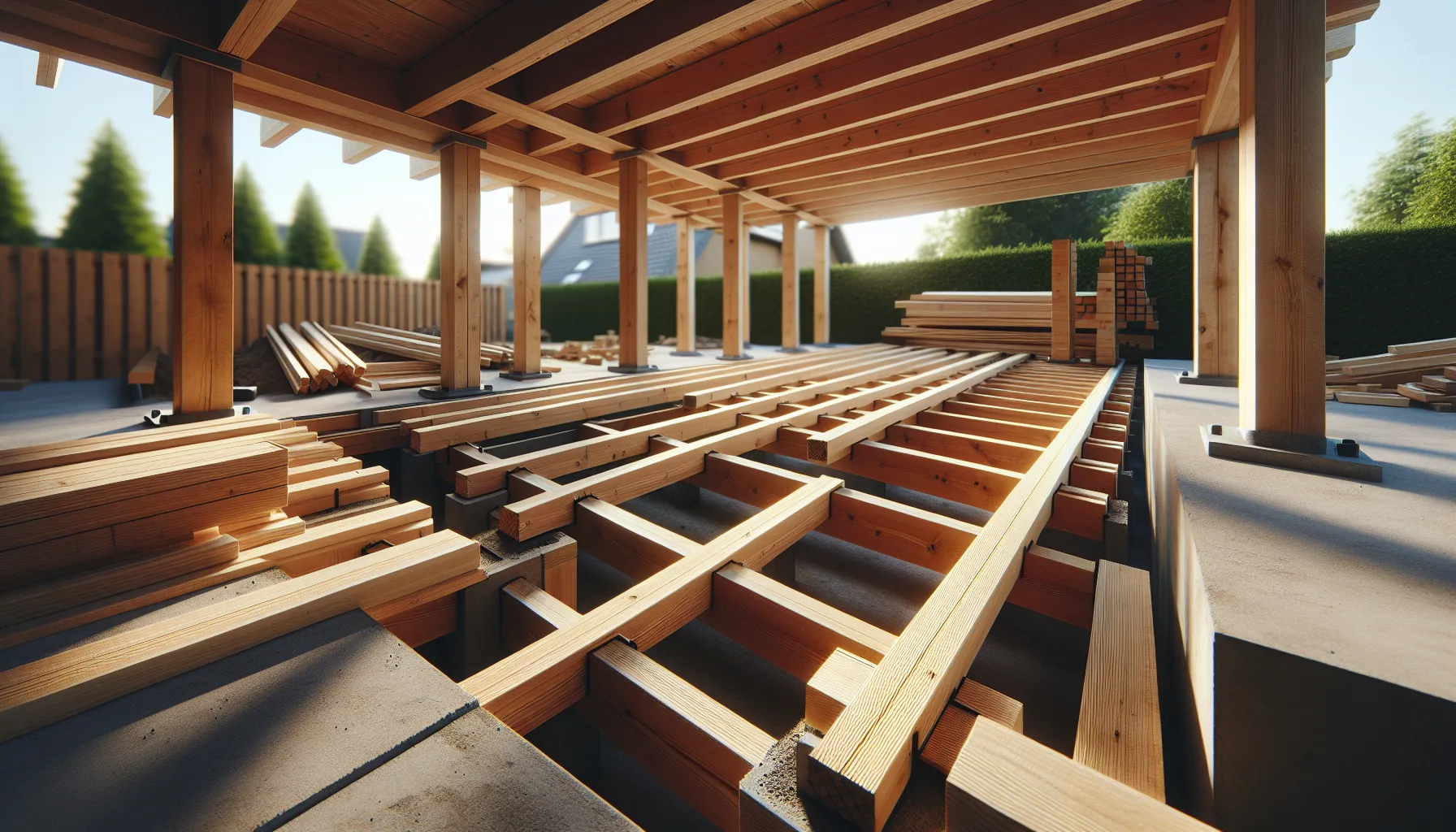
The most common fix. Sister an additional joist alongside every existing one in the hot tub zone. Use the same timber size as the originals (or larger) and bolt them together with M12 coach bolts at 400mm centres. This doubles the load capacity of that section.
Adding Intermediate Support Posts
If your joists span more than 1.8 metres without support, add intermediate posts on concrete pad foundations (minimum 450mm × 450mm × 300mm deep). Each post should sit on a post anchor bolted to the pad, not just resting on the surface.
Upgrading Bearers
Swap the bearers under the hot tub area for larger section timber — 200mm × 100mm is the minimum for hot tub support. Bearers should span no more than 1.2 metres between posts.
Cross-Bracing
Add diagonal bracing between posts using 100mm × 50mm timber or galvanised steel braces. This prevents lateral movement and racking, which becomes critical when 2+ tonnes is sitting on the structure.
Deck Materials and Hot Tub Compatibility
Pressure-Treated Softwood
The most common deck material in the UK. It’ll handle the weight if the structure is right, but softwood decking boards themselves aren’t the load-bearing element — the joists and bearers underneath do that work. The main concern is moisture. Hot tubs splash, and continuous dampness accelerates rot even in pressure-treated timber. Allow at least 5mm gaps between boards for drainage.
Composite Decking
Composite boards (Trex, Millboard, Eva-Last) are fine for the surface, but they’re heavier than timber boards — about 3-4 kg per metre length versus 1.5-2 kg for softwood. Factor this extra dead load into your calculations. The subframe underneath composite decking is still timber or aluminium, and that’s what needs to be rated for the hot tub weight.
Hardwood Decking
Ipe, balau, or cumaru decking is stronger and more rot-resistant than softwood, but it’s expensive — about £80-120 per square metre for the boards alone. For the hot tub zone specifically, it’s worth considering. It handles moisture brilliantly and won’t need replacing every 8-10 years like treated softwood.
Aluminium Subframes
If you’re building from scratch or doing a major rebuild, aluminium subframe systems (like AluDek or similar) are worth the premium. They won’t rot, they’re dimensionally stable, and they’re typically rated for much higher loads than timber. Budget about £60-80 per square metre for the subframe on top of whatever decking surface you choose.
Alternatives to Putting a Hot Tub on a Deck
Sometimes the honest answer is: don’t put it on the deck.
Concrete Pad
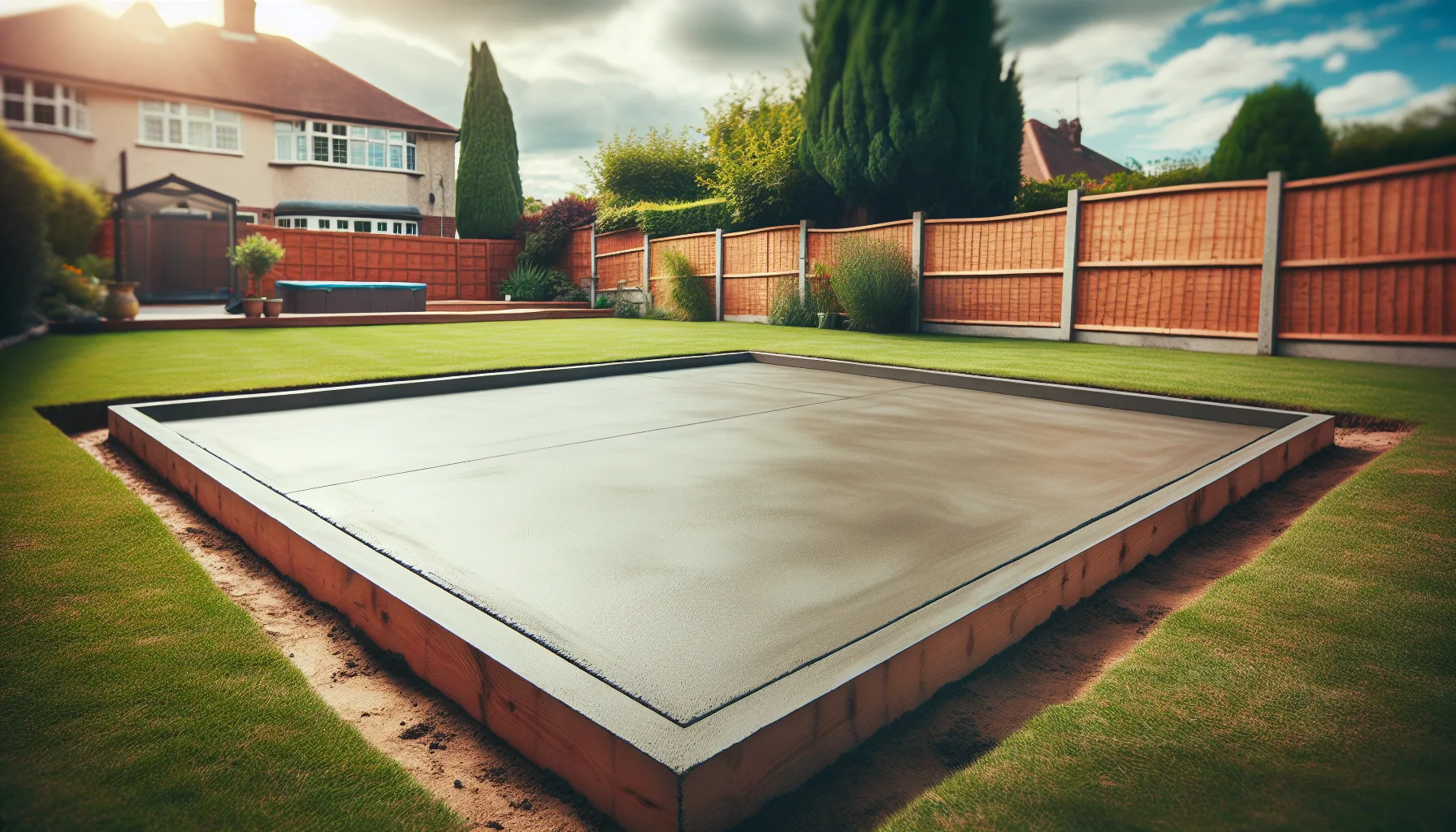
A reinforced concrete pad is the gold standard — we cover all the options in our guide to choosing a hot tub base. A 150mm-thick pad with steel mesh reinforcement will handle any domestic hot tub with ease. Cost is typically £40-60 per square metre including excavation, hardcore sub-base, and finishing. Allow £400-600 for a typical hot tub pad. We’ve seen these done in a weekend by a competent groundworker.
Paving Slabs
Thick paving slabs (50mm minimum) on a compacted hardcore base work well for lighter tubs. The key is getting the sub-base right — at least 100mm of compacted MOT Type 1 underneath. Avoid standard 35mm patio slabs on sand, which will crack and shift under concentrated load.
Gravel Pad
A popular budget option, especially for inflatable hot tubs. Excavate 150mm deep, lay landscape membrane, fill with 20mm gravel, and compact it level. Supports the weight fine but isn’t the most comfortable surface for barefoot walking. Budget about £15-20 per square metre.
Purpose-Built Platform
If you want the hot tub raised to deck height, build a dedicated platform specifically for it. This lets you engineer the substructure purely for the tub’s weight without worrying about the rest of the deck. Connect it to the main deck with a short walkway. More expensive upfront but avoids compromising the existing deck structure. Factor this into your overall hot tub costs — the base work is often forgotten in the budget.
Getting a Structural Engineer Involved
For anything bigger than a small 2-person tub on a modern, well-built deck, we’d say get a structural engineer to take a look. It’s not the most exciting way to spend £300-500, but it’s a lot cheaper than rebuilding a collapsed deck.
What They’ll Check
- Joist sizes, spacing, and span against the proposed load
- Bearer and post capacity including the foundations
- Connection details — how the deck attaches to the house, how posts connect to bearers
- Soil conditions — whether the existing foundations are adequate
- Overall structural integrity — including any deterioration from age or moisture
What You’ll Get
A written report confirming whether the deck can take the load as-is, or a specification for the reinforcement needed. This report is worth its weight in gold for insurance purposes — more on that below.
Finding a Structural Engineer
Look for a chartered structural engineer (CEng MIStructE) or a member of the Institution of Structural Engineers. The Institution of Structural Engineers has a searchable directory. Expect to pay £300-500 for a site visit and written report. Some hot tub installers have engineers they work with regularly, which can streamline the process.
Insurance and Building Regulations
Home Insurance
Here’s the bit most people forget. A hot tub on a deck can affect your home insurance. Most policies require you to notify your insurer about structural additions or significant changes — a 2-tonne hot tub on a deck qualifies. If the deck collapses because you didn’t have it checked, and you hadn’t told your insurer about the hot tub, you could find your claim rejected.
Building Regulations
In England and Wales, decking over 300mm above ground level typically needs building regulations approval under Approved Document A (Structure). Adding a hot tub to an existing deck that was built to minimum spec could mean it no longer meets the structural requirements it was originally approved under. If the deck was built without approval in the first place, now’s the time to sort that out.
Planning Permission
A hot tub itself rarely needs planning permission as it counts as a chattel (moveable object). However, if you’re building a new deck or substantially modifying an existing one, and it’s over 300mm high or covers more than 50% of your garden, you may need planning approval. Check with your local council planning department — a quick phone call usually clears it up.
Real-World Deck Hot Tub Setups That Work
After speaking with hot tub owners across dozens of forums and installation reviews, there are clear patterns in what works and what doesn’t.
The Ground-Level Deck
Decks built at or near ground level (under 300mm high) are the easiest to reinforce because you can add support directly beneath them. Short joist spans, posts directly onto concrete pads, and easy access underneath for maintenance. If you’re building new, this is the simplest approach — keep it low.
The Sunken Deck Approach
Some owners partially sink the hot tub into the deck, with the top rim sitting flush with the deck surface. This looks brilliant and lowers the centre of gravity, but it requires the ground beneath to support the weight — essentially the tub sits on a pad with the deck wrapping around it cosmetically. The deck isn’t bearing the load at all.
The Dedicated Corner Section
Build one corner of the deck with a beefed-up substructure specifically for the tub — 200mm × 100mm bearers, doubled joists at 300mm centres, posts on deep concrete pads. The rest of the deck stays standard spec. This is the most practical approach for existing decks where a full rebuild isn’t realistic.
Frequently Asked Questions
Can I put an inflatable hot tub on my deck? Possibly, but don’t assume it’s fine just because the tub itself is light. A Lay-Z-Spa filled with water and four adults still weighs around 1,200-1,400 kg. That’s less than a hard-shell tub but still well beyond standard deck ratings. Check your joist sizes and spacing before committing.
How much does it cost to reinforce a deck for a hot tub? Budget £800-2,000 depending on the current state of your deck and how much work is needed. Doubling joists and adding posts is at the lower end. A complete subframe replacement under the hot tub zone pushes toward the higher end. A structural engineer’s report adds another £300-500.
Do I need planning permission to put a hot tub on my deck? Generally no — the hot tub itself is a moveable chattel. But if modifying the deck structure triggers building regulations (decking over 300mm high, or significant structural changes), you may need building regulations approval rather than planning permission. Check with your local council.
Can I spread the weight with plywood sheets? A weight distribution platform helps spread the load across more joists, which is useful. But it’s not a structural fix — if your joists can’t handle the total load, spreading it more evenly across failing joists doesn’t solve the underlying problem. Think of it as a supplement to reinforcement, not a replacement.
Will my deck warranty cover hot tub damage? Almost never. Most deck installation warranties exclude damage from loads exceeding the original design specification. If you place a hot tub on a deck that wasn’t engineered for it and something breaks, you’re on your own. Get an engineer’s report before installing.