You’ve been looking at swim spas for weeks now. Maybe months. You keep switching between tabs, comparing models that all look vaguely the same, and the prices range from £8,000 to £35,000 with no obvious reason why. One has 45 jets, another has 72 — does that even matter? And the sizes… you measured your garden three times and you’re still not sure if a 4-metre or 6-metre model will fit. Sound familiar?
Choosing a swim spa is a bigger decision than buying a hot tub. It’s more expensive, heavier, harder to move, and you’ll be living with it for 10-15 years. Get it right and you’ve got a year-round pool, fitness machine, and relaxation space rolled into one. Get it wrong and you’ve got an expensive garden ornament that’s too cold to swim in and too cramped to enjoy.
This guide covers everything you actually need to know about how to choose a swim spa — from the dimensions that matter to the jet systems that separate a decent current from a glorified bubble bath. No fluff, no salesman spin. Just practical advice based on what actually works in a UK garden.
Why a Swim Spa Over a Pool or Hot Tub?
Before we get into the specifics, it’s worth being clear about what a swim spa actually gives you compared to the alternatives.
A traditional swimming pool in the UK costs £40,000-£80,000 installed, needs planning permission in most cases, takes months to build, and sits unused from October to April unless you spend a fortune on heating. A swim spa costs a fraction of that, doesn’t usually need planning permission (more on this later), arrives on a crane and is ready to use within a week, and stays at a usable temperature year-round for a sensible energy cost.
Compared to a regular hot tub, a swim spa gives you the ability to actually exercise. You can swim against a current, do aqua jogging, resistance training, and rehabilitation exercises. Most swim spas also have a separate hot tub zone with massage seats, so you’re not giving anything up — you’re adding to it.
The sweet spot is someone who wants to swim regularly but doesn’t have the space, budget, or patience for a full pool. Families with kids who want something bigger than a hot tub also get brilliant value from swim spas.
Swim Spa Sizes: What Actually Fits in a UK Garden?
Size is where most people start, and it’s where most people get confused. Swim spas come in a range of lengths, and each serves a different purpose.
Small Swim Spas (3.5-4.5 Metres)
These are the entry point. Models like the Hydropool Self-Cleaning 12FFP (3.66m) or the Wellis Rio Grande (4.2m) fall into this bracket. They’re priced between £12,000 and £18,000 typically.
At this size, you can swim in place against a current, but the swimming area is compact. You’ll get a decent workout doing breaststroke or freestyle, but taller swimmers (over 6 foot) may feel cramped. The hot tub seating area is usually limited to 2-3 seats.
Best for: couples, smaller gardens, people who primarily want aqua fitness rather than long-stroke swimming.
Medium Swim Spas (4.5-5.5 Metres)
This is the most popular size in the UK market, and for good reason. Models like the Endless Pools E550 (4.57m), the Jacuzzi PowerPro (5.18m), and the Master Spas H2X Trainer 15D (4.57m) sit here. Budget: £16,000-£25,000.
You get a proper swim lane that works for most adults, plus a decent relaxation area with 3-5 massage seats. The current systems at this price point are usually strong enough for serious swimmers. This is the size that fits comfortably in most UK back gardens — you need roughly 6m x 4m of usable space once you account for access around the sides.
Best for: families, regular swimmers, anyone who wants both exercise and relaxation without compromise.
Large Swim Spas (5.5-6+ Metres)
The big boys. The Endless Pools E700 (5.94m), the Hydropool AquaSport 19DTAX (5.79m), and the dual-zone models from Master Spas fall into this category. Prices range from £22,000 to £35,000+.
At this length, you often get a true dual-zone system — the swim area and the hot tub section have completely separate heating and filtration. This means you can keep the swimming zone at 26-28°C for exercise while the hot tub section sits at 37-38°C for relaxation. In a single-zone model, you’re always compromising on temperature.
Best for: serious swimmers, large families, anyone with the garden space and budget who doesn’t want to compromise.
Measuring Your Space
Here’s what people forget: you need more space than just the swim spa footprint.
- 50cm clearance on all sides for maintenance access (at minimum — 75cm is better)
- One short end needs enough room to remove the access panel for pump servicing
- Overhead clearance matters if you’re under a pergola or near trees
- Crane access — how does a 2-tonne unit get from the road to your garden? Most deliveries use a hiab crane, and the operator needs a clear line of sight. If your only access is through the house… that’s not going to work
- Weight on the ground — a filled swim spa weighs 4,000-8,000 kg. Your patio slabs will not cut it. You need a reinforced concrete base, typically 150mm thick. Check our guide to choosing a hot tub base — the same principles apply, but you’ll need a larger and thicker slab
Grab a tape measure and actually mark it out with string or tape on the ground. Stand in the marked area. Walk around it. You’d be amazed how many people order a swim spa and then realise the path beside it is too narrow to walk down.
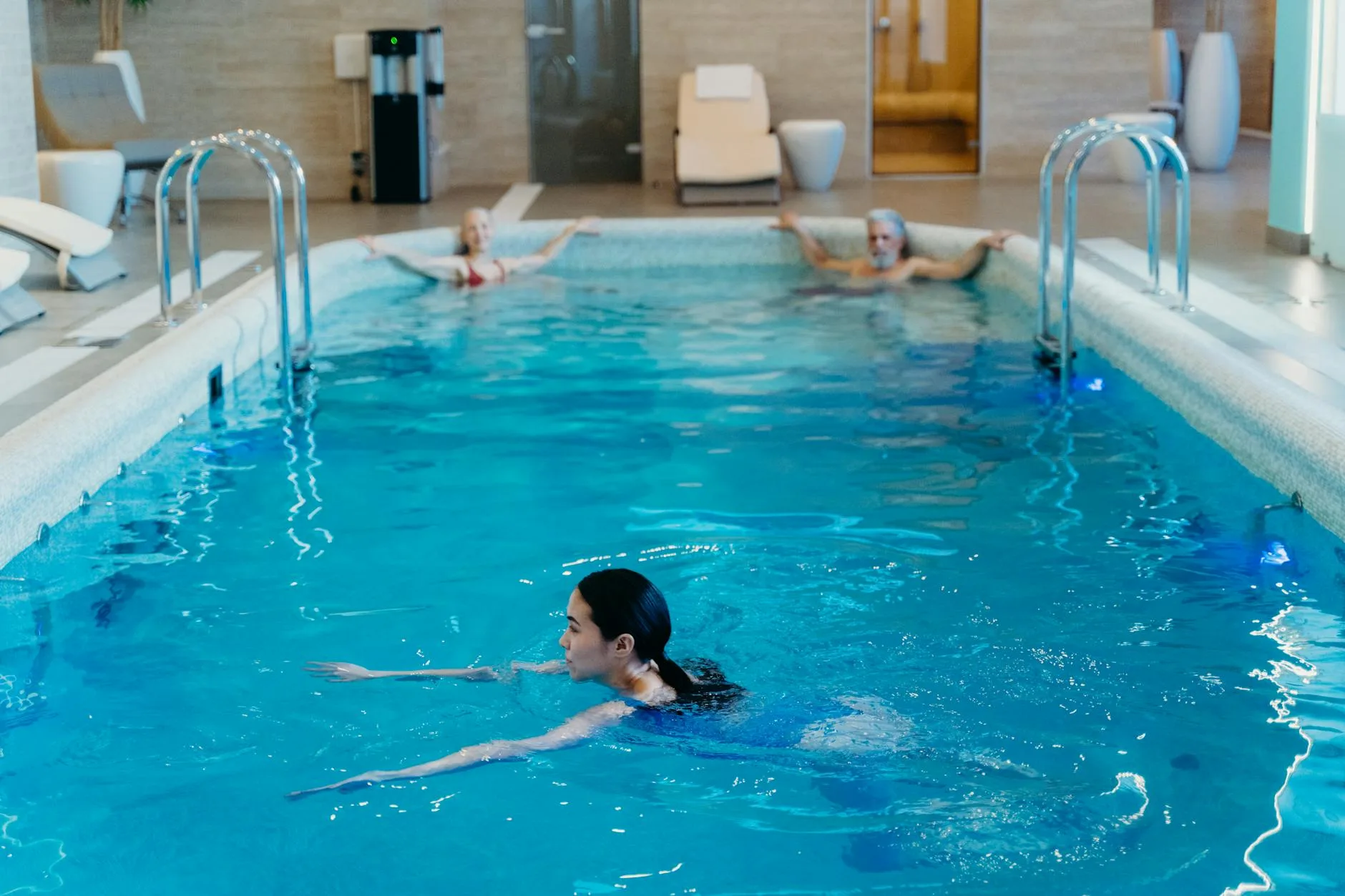
How to Choose Swim Spa Jets: The Current Is Everything
If there’s one thing that separates a good swim spa from a disappointing one, it’s the swim current. This is the feature you’re really paying for, and it’s where the biggest quality differences hide.
Jet-Driven Systems
Most swim spas in the £10,000-£20,000 range use jet-driven propulsion. Multiple jets (typically 3-6 large swim jets) pump water towards you to create a current you swim against. This is the most common system and it works well, but not all jet-driven currents are equal.
What to look for:
- Jet placement — the jets should be spread across the full width of the swim area, not clustered in the centre. A narrow current means you’re constantly drifting sideways
- Adjustable flow — you need to be able to dial the current from gentle (for aqua walking) to strong (for competitive-pace swimming). Some cheaper models have just on/off, which is useless
- Turbulence — this is the big issue with jet systems. Cheap jets create a choppy, aerated current that pushes you around rather than flowing past you. Better systems use laminar flow technology to create a smoother, wider current
- Number of pumps — more pumps generally means a stronger, more consistent current. Look for models with dedicated swim pumps separate from the massage jet pumps
Popular jet-driven models in the UK include the Hydropool range, Jacuzzi swim spas, and the Master Spas H2X series. Prices for decent jet-driven models start around £12,000.
Propeller-Driven Systems (Swim Current Generators)
The premium option. Instead of jets, a paddlewheel or propeller generates the current. Endless Pools pioneered this with their Swimcross system, and it remains the gold standard.
The advantage is a wider, deeper, smoother current that feels much more like swimming in open water. There’s less turbulence, less chop, and the current is more consistent across the full swim lane. Swimmers who’ve tried both almost always prefer a propeller system.
The downside? Cost. Propeller-based swim spas start around £20,000 and quickly climb to £30,000+. The Endless Pools E-Series and R-Series are the main players, along with TidalFit models. For related guidance, see our Swim Spa Running Costs: What to Expect guide.
Hybrid Systems
Some manufacturers now combine jet propulsion with current-smoothing technology. The Hydropool Self-Cleaning range, for example, uses their AquaTrainer jet system with flow directors to reduce turbulence. Master Spas uses a similar approach in their H2X Challenger series.
These hybrids sit in the £15,000-£22,000 range and offer a good middle ground. The current isn’t as smooth as a true propeller system, but it’s noticeably better than basic jets.
How to Test the Current
If you can, visit a dealer showroom with a working display model. Wear your swimsuit — many dealers offer wet tests. This is the single best thing you can do before buying.
When testing, pay attention to:
- Can you swim freestyle without being pushed sideways?
- Is the water choppy or smooth?
- Can you adjust the speed to match different strokes?
- How wide is the usable swim lane? (Ideally at least 1.5m)
- Is it noisy? Some jet systems sound like a jet engine at full power
If you can’t wet-test, at minimum watch video reviews of the specific model you’re considering. Manufacturer videos always show their best angle — look for independent YouTube reviews from actual owners.
Heating, Insulation & Running Costs in the UK
Running costs are the thing nobody talks about in the showroom. A swim spa in the UK will cost between £80 and £200 per month in electricity, depending on the model, insulation, temperature, and how often you use it.
What Drives the Cost
- Temperature — every degree costs money. A swim spa kept at 28°C for exercise costs notably less to run than one held at 36°C. Dual-zone models help here because you’re only heating the smaller hot tub section to full temperature
- Insulation quality — this is the biggest differentiator in running costs. Full-foam insulation in the cabinet walls and base is the minimum standard. Premium models add thermal blankets, reflective barriers, and insulated covers
- Cover quality — a thick, well-fitting hardcover with a good seal saves more energy than almost any other single feature. Budget £400-700 for a replacement cover when the original wears out (typically after 3-5 years)
- Climate — UK winters mean your swim spa works harder from November to March. Expect winter electricity bills to be 30-50% higher than summer
- Usage — every time you open the cover, you lose heat. A family using the spa daily will spend more than a couple using it twice a week
Energy-Saving Features Worth Paying For
- Dual-zone heating — separate temperature control for swim and spa areas
- Variable-speed pumps — use less energy at low speeds for circulation and filtration
- Full-foam insulation — not just the shell, but the cabinet and base too
- Smart controls — schedule heating for off-peak electricity hours. If you’re on an Economy 7 or Octopus Go tariff, this alone can cut running costs by 30%
- Heat recovery systems — some models (Hydropool’s Self-Cleaning range is a good example) recapture waste heat from the pumps and redirect it back into the water
If energy costs are a major concern — and for most UK buyers they should be — check whether the swim spa you’re considering has any independent energy efficiency certification. The California Energy Commission (CEC) tests are the closest thing to a standard, though not all UK-sold models are listed.
Features That Matter (And Features That Don’t)
Swim spa brochures love to list 50 features. Here’s which ones actually affect your day-to-day experience.
Worth Paying For
- Adjustable swim current — non-negotiable. You need at least 5-6 speed settings, ideally with a wireless remote so you can adjust mid-swim
- LED lighting — swim spas look spectacular lit up at night, and underwater lights let you swim safely after dark. Almost all models include these now, but check the colour options and whether they’re perimeter or full-floor lighting
- Built-in WiFi monitoring — being able to check the temperature and adjust settings from your phone is surprisingly useful. Especially in winter when you want to boost the temperature before heading out
- Self-cleaning or low-maintenance filtration — Hydropool’s self-cleaning system is the leader here. It skims and filters constantly, reducing the time you spend on water chemistry. Expect to pay a premium, but your future self will appreciate it. For a primer on water maintenance, our beginner’s guide to hot tub chemicals covers the essentials
- Comfortable seating in the spa zone — if you’re spending £15,000+, the massage seats should be genuinely comfortable, with varied jet layouts for different muscle groups. Sit in them before you buy
- Swim tether attachment point — a built-in anchor point for a resistance tether or swim belt. Useful for interval training and for weaker swimmers who want extra security in the current
Nice but Not Essential
- Bluetooth speakers — fun for the first month, then you’ll just use a separate speaker anyway. The built-in ones are never as good as a decent Bluetooth speaker you already own
- Waterfall features — pretty but they cool the water faster and add noise. Most people turn them off after the novelty fades
- Aromatherapy systems — smell nice for about ten minutes. The cartridges cost £10-15 each and last one session
Skip These
- Ozone or UV sanitation “replaces chemicals” — it doesn’t. These systems reduce chemical use slightly but you still need chlorine or bromine. Don’t let a salesperson tell you otherwise. Our chemicals glossary explains what each sanitiser actually does
- Built-in TV screens — they fog up, the resolution is terrible, and you can’t see them while swimming. A waterproof tablet mount costs £20
- Excessive jet counts — a swim spa advertising 120 jets is not twice as good as one with 60. Past about 40-50 massage jets in the spa zone, you’re just splitting the same water pressure across more holes. Focus on jet placement and pump power, not the number

Installation & Planning Permission in the UK
Do You Need Planning Permission?
In most cases, no. Swim spas are classified as portable equipment (even though they weigh several tonnes), similar to a hot tub. Under permitted development rights, you can install one without planning permission as long as:
- It’s in your rear garden, not the front
- It doesn’t cover more than 50% of your garden area
- It’s not in a conservation area or listed building curtilage (where stricter rules apply)
- It’s not raised more than 30cm above ground level on a platform
That said, if your garden is overlooked and you’re building a raised deck or enclosure around the swim spa, the structure might need planning permission even if the spa itself doesn’t. The Planning Portal’s permitted development guidance is worth bookmarking. And if you’re unsure, a quick phone call to your local planning department costs nothing and could save you thousands.
Electrical Requirements
A swim spa needs a dedicated electrical supply — typically a 32A or 40A feed from a consumer unit, wired by a Part P certified electrician. Some larger models need a three-phase supply, which is less common in residential properties and costs more to install (£1,500-3,000 for three-phase if you don’t already have it).
Budget £500-800 for a standard single-phase electrical installation. Your dealer may include this or offer it as an add-on.
Base Preparation
As mentioned, you need a reinforced concrete base. For a medium swim spa (5m x 2.3m), you’re looking at a base of at least 5.5m x 3m, 150mm deep, with steel mesh reinforcement. Cost: £1,500-2,500 depending on your area and ground conditions. If you’ve got soft or sloping ground, add drainage and possibly piling — this can push costs to £4,000+.
Don’t skip this step. A swim spa on an inadequate base will crack, settle unevenly, and void your warranty. Our hot tub base guide covers the fundamentals — for a swim spa, just scale everything up.
Brands Worth Looking At in the UK
The UK swim spa market has grown hugely in the last five years. Here are the brands that consistently get good feedback from owners.
- Endless Pools — the propeller-current pioneer. Premium price (£20,000-35,000) but widely regarded as the best swim experience. The E-Series is their most popular in the UK
- Hydropool — Canadian manufacturer with excellent self-cleaning technology. Their AquaTrainer range (£15,000-28,000) is popular with UK buyers. Strong dealer network
- Master Spas — American brand with a wide range. The H2X Trainer series offers good value in the £14,000-22,000 range. Their Michael Phelps Signature Series is the premium line
- Jacuzzi — yes, they make swim spas too. The PowerPro range is solid mid-market (£16,000-24,000) with decent jets and good build quality
- Wellis — Hungarian manufacturer offering competitive pricing (£10,000-18,000) with respectable build quality. Worth considering if budget is tight
- TidalFit — propeller-based swim current at a lower price point than Endless Pools (£15,000-25,000). Growing presence in the UK
For more context on what makes a brand reliable, our guide to UK hot tub brands covers the reputation markers and red flags that apply equally to swim spa manufacturers.
What About Cheap Swim Spas?
You’ll see swim spas on eBay and from direct-import websites for £5,000-8,000. Be very cautious. At that price point, common issues include:
- Weak swim currents that barely create a usable flow
- Poor insulation that costs a fortune to run
- Thin shells that flex and crack
- No local dealer support or warranty service
- Electrical components that aren’t CE marked
A swim spa is a significant investment. Spending an extra £5,000-8,000 on a reputable brand with proper dealer support is money well spent over a 10-15 year ownership period.
Frequently Asked Questions
How much does a swim spa cost in the UK? Swim spas in the UK typically cost between £10,000 and £35,000 for the unit alone. Budget an additional £2,000-4,000 for installation including the concrete base, electrical supply, and delivery by crane. Running costs are typically £80-200 per month in electricity.
Can you swim properly in a swim spa? Yes, but the experience depends heavily on the swim current quality. Propeller-driven systems from brands like Endless Pools provide a smooth, wide current closest to open-water swimming. Jet-driven systems are more affordable but the current can be narrower and more turbulent. A wet test at a dealer showroom is the best way to judge.
Do swim spas need planning permission in the UK? Most swim spas don't need planning permission under permitted development rights, provided they're in your rear garden, don't cover more than 50% of the garden, and aren't raised more than 30cm above ground level. Properties in conservation areas or listed building curtilages may have additional restrictions.
How much electricity does a swim spa use? A well-insulated swim spa in the UK typically costs £80-200 per month to run. The main factors are water temperature, insulation quality, cover condition, and usage frequency. Dual-zone models and variable-speed pumps help reduce costs. Using off-peak electricity tariffs can cut bills by up to 30%.
What size swim spa do I need? For most UK buyers, a medium swim spa (4.5-5.5 metres long) offers the best balance of swim space and garden fit. Smaller models (3.5-4.5m) suit couples and compact gardens, while larger models (5.5m+) are ideal for serious swimmers or families wanting separate swim and spa zones. Remember to allow at least 50cm clearance on all sides for maintenance.