You have decided on a hot tub. The budget is set, you have measured the garden, and you are ready to order — until someone asks “have you thought about putting it indoors?” Suddenly you are down a rabbit hole of ventilation requirements, structural loading, and whether your bathroom floor can take 1,500kg of water. Indoor hot tubs offer year-round comfort without weather dependence, but the installation challenges are real. Here is the honest comparison to help you decide where yours should live. For related guidance, see our Best 6-Person Hot Tubs 2026 guide. For related guidance, see our Best Inflatable Hot Tubs 2026: UK Garden Tested guide. For related guidance, see our Salt Water vs Chlorine Hot Tubs: Pros & Cons guide.
In This Article
- Outdoor Hot Tubs: The Traditional Choice
- Indoor Hot Tubs: The Luxury Option
- Installation Requirements Compared
- Running Costs: Indoor vs Outdoor
- Ventilation and Moisture: The Indoor Challenge
- Structural Considerations for Indoor Installation
- Which Is Better for Your Situation
- Common Mistakes with Each Option
- Frequently Asked Questions
Outdoor Hot Tubs: The Traditional Choice
The vast majority of UK hot tubs sit outdoors — on decking, patios, concrete pads, or purpose-built bases in gardens. This is the simpler installation, the cheaper option, and for most people the more practical choice.
Advantages
- Simpler installation — a level base and electrical supply are the only structural requirements
- No ventilation concerns — steam dissipates naturally into open air
- Scenic enjoyment — stargazing, garden views, fresh air while you soak
- Easier delivery — no navigating through doorways, hallways, or up staircases
- No moisture damage risk — splashes and steam cannot damage walls or ceilings outdoors
- Lower overall cost — base construction plus electrical is typically £1,500-3,000 total installation
Disadvantages
- Weather exposure — rain, wind, and cold affect enjoyment (though many people love the contrast)
- Higher running costs — heat loss to ambient air is greater outdoors, especially in winter
- Privacy concerns — overlooked gardens need screening or fencing
- Seasonal use patterns — some owners use theirs less in winter despite having it available
- Pest and debris management — leaves, insects, bird droppings require more frequent cover use and cleaning
Best Outdoor Positions
The ideal spot balances access (close to the house for towel runs), privacy (not overlooked by neighbours), level ground, and proximity to the electrical supply. Within 10 metres of the consumer unit keeps electrician costs reasonable. A south or west-facing position catches evening sun — pleasant in summer, irrelevant in winter.
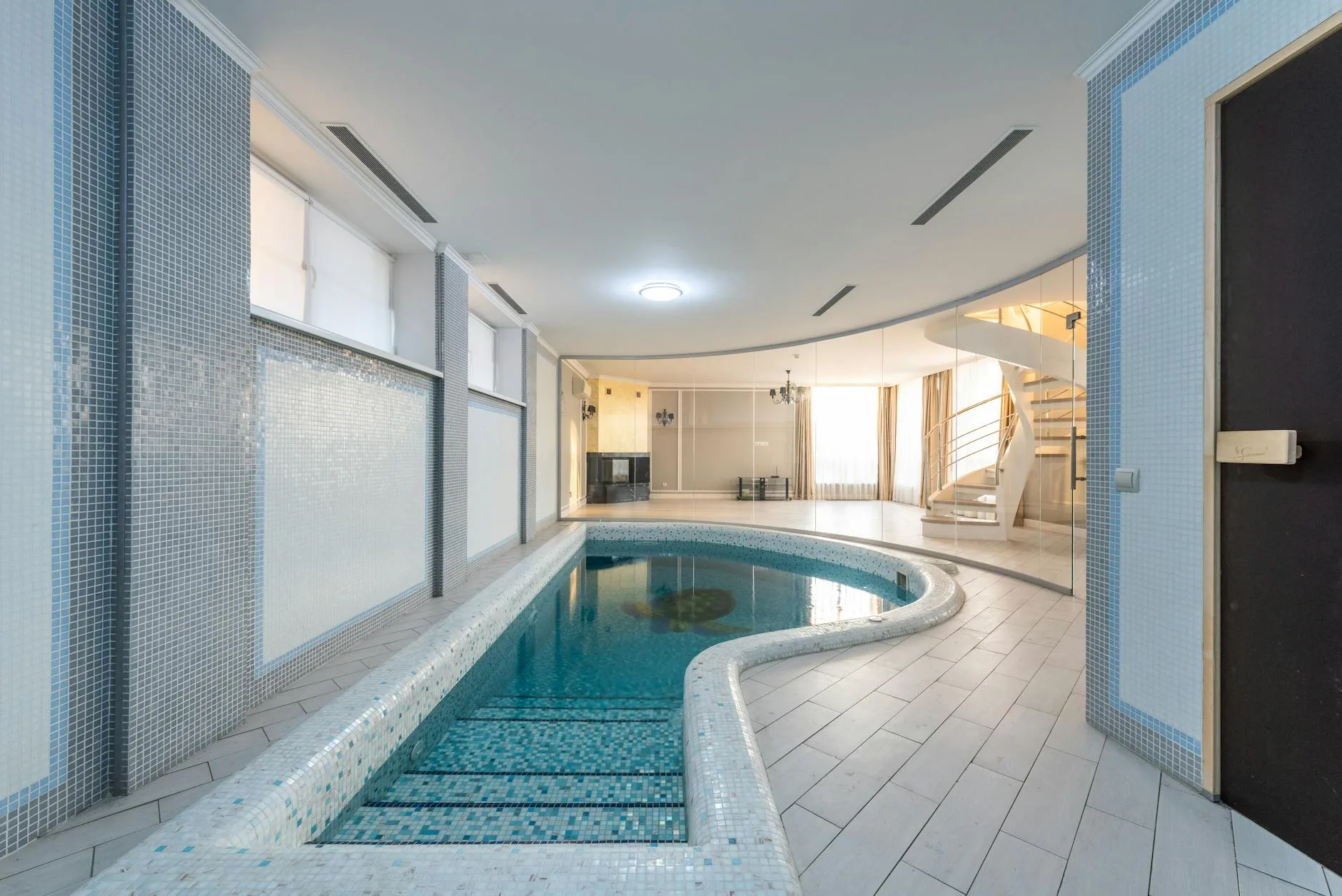
Indoor Hot Tubs: The Luxury Option
Indoor installations range from purpose-built spa rooms to converted garages, conservatories, and basement installations. The experience is different — controlled, private, and weather-independent — but the installation complexity is higher.
Advantages
- Year-round consistent use — no weather dependency, same experience in January as July
- Lower running costs — ambient indoor temperature reduces heat loss (more on this below)
- Complete privacy — no overlooking, no need for garden screening
- No cover management — debris is not an issue indoors, though a cover still helps heat retention
- Property value — a well-executed spa room adds genuine value to a home (whereas outdoor tubs do not)
Disadvantages
- Ventilation essential — without proper extraction, moisture destroys the room within months
- Structural requirements — the floor must support 1,500-2,000kg (filled tub plus occupants)
- Installation cost — £5,000-15,000+ for a proper spa room (ventilation, waterproofing, drainage, electrical)
- Delivery challenges — getting a 2m wide tub through your house to the installation room
- Chemical smell concentration — chlorine/bromine off-gasses are noticeable in enclosed spaces
- Noise — pump and jet noise reverberates more in indoor spaces than outdoors
Installation Requirements Compared
Outdoor
- Base: concrete pad (100mm thick, reinforced), paving slabs on compacted sub-base, or structural decking rated for the weight. Cost: £500-2,000.
- Electrical: dedicated 32A or 40A supply from consumer unit, installed by a Part P qualified electrician with RCD protection. Cost: £500-1,500 depending on distance from the board.
- Drainage: somewhere for emptied water to go — soakaway, storm drain, or garden drainage channel. Usually achievable with simple gravity hose run.
- Access: clear path from road to installation point for delivery (most tubs arrive on a pallet via crane or manual carry).
Indoor
Everything above, PLUS:
- Structural survey: professional assessment that the floor can handle the load (£200-500 for a structural engineer’s report)
- Ventilation: mechanical extraction system capable of removing moisture-laden air continuously. Not a bathroom extractor fan — a proper HVAC dehumidification system rated for the room volume. Cost: £2,000-5,000.
- Waterproofing: tanking the floor and lower walls (same approach as wet room construction). Cost: £1,000-3,000 depending on room size.
- Drainage: floor drain connected to waste water (Building Regulations apply). Cost: £500-1,500.
- Chlorine-resistant finishes: ceiling, walls, and any exposed surfaces must resist moisture and chemical vapour. Standard plasterboard fails within a year.
Running Costs: Indoor vs Outdoor
The Heat Loss Equation
A hot tub maintains 37-40°C. The cost to maintain that temperature depends on the difference between the water temperature and the surrounding air. Outdoors in winter (0-5°C ambient), the differential is 32-40°C. Indoors (18-22°C ambient), the differential drops to 15-22°C — roughly half.
Typical Monthly Costs
- Outdoor, winter (October-March): £40-80/month electricity
- Outdoor, summer (April-September): £20-40/month electricity
- Indoor, year-round: £20-35/month electricity
Indoor tubs save roughly £200-400/year on heating compared to outdoor. However, the dehumidification system draws electricity too (typically £15-30/month), partially offsetting the savings. Net saving: £100-250/year indoors — meaningful over a decade but not enough to justify indoor installation on running costs alone.
The Real Cost Difference
The installation premium for indoor (£5,000-15,000 extra) means running cost savings take 20-60 years to break even. Nobody installs a hot tub indoors to save money — they do it for the experience, privacy, and year-round convenience. The full cost breakdown covers purchase, installation, and ongoing costs in detail.
Ventilation and Moisture: The Indoor Challenge
This is where indoor installations succeed or fail. A hot tub at 38°C in a 20°C room produces enormous amounts of water vapour — 2-5 litres per hour depending on tub surface area and jet usage. Without extraction, this moisture condenses on every cold surface: windows, walls, ceiling, light fittings, and structural timbers.
What Happens Without Proper Ventilation
- Month 1-3: condensation on windows, musty smell developing
- Month 3-6: black mould appears on ceiling and walls, paint peeling
- Month 6-12: timber rot begins in ceiling joists and window frames
- Year 2+: structural damage, electrical corrosion, potential ceiling collapse
This is not hypothetical — it happens in poorly planned indoor installations regularly. The HSE legionella guidance also applies to indoor hot tub environments where warm moisture creates ideal conditions for bacterial growth.
What Proper Ventilation Looks Like
A dedicated dehumidification unit (not a household dehumidifier — an industrial spa unit) that maintains relative humidity below 60% while the tub is in use. Brands like Calorex, Dantherm, and Certikin make units specifically for domestic spa rooms. They recirculate air, extract moisture, and some models recover heat from the extracted air to warm the room — reducing overall energy costs.
Structural Considerations for Indoor Installation
Weight Calculations
A 6-person hot tub filled with water weighs approximately:
- Shell: 200-350kg (empty)
- Water: 1,000-1,500kg (1,000-1,500 litres)
- Occupants: 300-500kg (6 adults)
- Total: 1,500-2,350kg concentrated in 3-4 square metres
Which Floors Can Handle It
- Ground floor concrete slab: almost always fine — concrete slabs handle this load without issue. Confirm slab thickness (100mm minimum) with a structural engineer if in doubt.
- Ground floor suspended timber: usually needs reinforcement. Standard UK floor joists (200mm × 50mm at 400mm centres) are not designed for this loading. Steel beams or additional joists underneath may be required.
- First floor or above: almost never suitable without major structural work. The concentrated load exceeds residential floor design assumptions by 3-4×.
- Garage conversion: usually on a concrete slab — check thickness and reinforcement, but often suitable.
- Basement: ideal — concrete floor at ground level with walls capable of supporting the building above. The best indoor location structurally.
Get Professional Advice
Never assume your floor can handle a hot tub. A structural engineer’s visit (£200-500) confirms load capacity before you commit £10,000+ to installation. The cost of investigation is negligible compared to the cost of floor failure — which can compromise the entire building structure above.

Which Is Better for Your Situation
Choose Outdoor If
- Your budget for total installation (tub + base + electrical) is under £8,000
- You enjoy the outdoor experience — fresh air, stars, seasonal contrast
- Your garden has a suitable private location with level ground
- You prefer simpler maintenance and replacement (outdoor tubs are easier to crane out when they reach end of life)
- You rent or plan to move within 5 years (outdoor tubs can be taken with you)
Choose Indoor If
- Total budget exceeds £15,000 for tub plus spa room build-out
- You value privacy over scenery
- You have a suitable ground-floor room (garage, conservatory, extension, basement)
- Your garden is small, overlooked, or exposed to extreme weather
- You want the spa to add permanent property value
- You will use it frequently (daily/weekly) year-round regardless of weather
The Conservatory Compromise
A glazed extension or conservatory gives you outdoor views with indoor weather protection. Natural ventilation is easier (open windows/doors), the glass structure handles moisture better than plasterboard, and the visual connection to the garden remains. If you already have a conservatory with a solid floor, this is often the most practical “indoor” option without a full spa room build.
Common Mistakes with Each Option
Outdoor Mistakes
- Insufficient base — paving slabs on sand settle unevenly, cracking the tub shell. Always use a properly compacted and reinforced base.
- Too far from the house — a 30-metre walk in freezing rain in a towel gets old fast. Position within 5-10 metres of a door.
- No privacy planning — installing then realising the neighbours have a clear view. Check sightlines before committing to a position.
- Undersized electrical supply — running a 13A plug-in hot tub on an extension lead is a fire hazard. Get proper hardwired supply installed professionally.
Indoor Mistakes
- Bathroom extractor fan as ventilation — a 100mm bathroom fan removes 90 litres/hour. Your tub produces 2,000-5,000 litres of vapour per hour at full jets. You need industrial-grade extraction.
- No floor drain — water will splash, overflow during maintenance, and drip from people exiting. Without a floor drain, you have puddles permanently. Tile with a fall toward a central drain.
- Standard plasterboard ceiling — it absorbs moisture, grows mould, and eventually collapses. Use moisture-resistant board with proper ventilation gap and clean hot tub filter maintenance to reduce airborne contaminants.
- Forgetting delivery access — measure every doorway, corridor, and staircase between your front door and the installation room. Most tubs are 200-220cm wide. Standard UK doors are 76cm. Plan the access route BEFORE ordering.
Frequently Asked Questions
Can I put a hot tub in my garage? Often yes — garages typically have concrete slab floors capable of handling the weight. Key requirements: waterproof the floor, install proper ventilation (not just the existing garage door), upgrade electrical supply, and ensure drainage. A garage conversion specifically for a hot tub costs £3,000-8,000 depending on the current state of the garage.
Does an indoor hot tub increase my home insurance? You should inform your insurer — an indoor hot tub represents a water damage risk and increases contents/buildings cover requirements. Some insurers charge a small premium (£50-100/year); others include it without charge if proper installation (qualified electrician, structural survey) is documented. Not declaring it risks voiding your policy if a claim arises.
How do I get a hot tub into my house? Through the largest available opening — patio doors, French doors, or a removable window. If no opening exceeds the tub width, crane-lifting over a flat roof or through a purpose-made opening is possible but adds £500-2,000 to delivery costs. Some manufacturers make split-assembly tubs designed for tight access.
Is an outdoor hot tub too cold in British winter? No — modern insulated tubs maintain 37-40°C regardless of ambient temperature down to -15°C. The heating system works harder (and costs more) in winter, but the water stays hot. Many UK owners report that winter is their favourite time to use an outdoor tub — the contrast between cold air and hot water is exhilarating rather than unpleasant.
Do I need planning permission for an indoor hot tub? Typically no — a hot tub installed inside an existing structure does not require planning permission as it constitutes a change of use of an interior room, not development. However, if you are building a new extension specifically to house a hot tub, the extension itself may require permission depending on size and location. Building Regulations approval may be needed for structural changes, electrical work, and drainage — consult your local authority.