A hot tub is one of those purchases where the excitement of ownership can override rational decision-making. You picture yourself relaxing in bubbling water on a cold evening, glass of wine in hand, stars overhead. What you don’t picture is the £150 electricity bill, the algae bloom because you forgot to test the water for two weeks, or the tub that looked perfect in the showroom but barely fits four people despite being advertised for six.
Getting the right hot tub for your situation — your garden, your budget, your usage pattern, your patience for maintenance — is worth the research. We spent three months visiting showrooms, speaking with installers, and reviewing owner feedback to put this guide together. Here’s everything you need to think about before spending £3,000 to £15,000 on something that’ll sit in your garden for the next decade.
Hard Shell vs Inflatable: The First Decision
This is the fundamental fork in the road, and the answer depends entirely on your budget and commitment level.
Inflatable Hot Tubs
Cost: £300-1,200 Lifespan: 2-4 seasons with regular use Setup: Inflate, fill with a hose, plug in, wait 12-24 hours to heat
Inflatable tubs (Lay-Z-Spa, Wave, MSpa) made hot tub ownership accessible. They’re genuine fun, and the newer models with HydroJet systems offer proper water massage, not just air bubbles.
The honest pros:
- Low financial commitment — test whether you’ll actually use a hot tub
- No installation needed — plug into a standard 13amp socket
- Can be packed away over winter (saves energy) or when you move house
- No planning permission concerns — temporary structure
The honest cons:
- Air jets blow cold air into hot water, which actually cools it. You’re choosing between bubbles and temperature
- Energy costs are 30-50% higher than equivalent hard-shell tubs (poor insulation)
- They heat slowly — 12-24 hours from cold. You can’t spontaneously decide to use one
- Puncture risk from pets, sharp objects, or ground debris
- They look like what they are: an inflatable pool with a heater
- Most can’t run the heater and jets simultaneously on a 13amp supply
Verdict: Brilliant for testing the concept. Not a long-term solution for serious hot tub users.
Hard Shell Hot Tubs
Cost: £3,000-15,000+ Lifespan: 10-20 years Setup: Professional delivery, electrical installation (usually 32amp), permanent base required
Hard-shell tubs are proper hydrotherapy equipment. Moulded acrylic shells, powerful water jets, efficient insulation, and built to withstand British weather year-round.
The honest pros:
- Proper water jets with adjustable flow and direction — genuine therapeutic massage
- Much better insulated — cheaper to run per session than inflatables
- Heats faster and holds temperature better
- Lasts 10-20 years with basic maintenance
- Adds genuine value to your property (estimated 3-5% by some estate agents)
The honest cons:
- Significant upfront investment
- Needs a permanent, level, load-bearing base
- Needs a dedicated 32amp electrical supply (£300-600 to install)
- Can’t easily be moved once installed
- Ongoing maintenance is more involved than “plug in and forget”
Verdict: If you know you want a hot tub and you’ll use it regularly, go hard shell. The initial cost is higher but the experience is incomparably better.
Size: How Many People Actually Use It?
Hot tub seating claims are optimistic. A “6-person” tub seats six adults only if everyone is friendly and nobody minds interlocking knees. Realistically:
- Advertised 4-person → comfortable for 2 adults, cosy for 3
- Advertised 5-6 person → comfortable for 3-4 adults
- Advertised 7-8 person → comfortable for 5-6 adults
For a couple, a 4-person tub is perfect — room to stretch out, lower running costs, and a smaller base footprint. For a family with kids or regular entertaining, go 6-person minimum.
Lounger vs All-Seat
Some tubs include a full-length lounger — a reclined seat that lets you stretch out with jets targeting your legs, back, and shoulders. They’re fantastic for solo soaks but take up the space of 2-3 seats.
Choose a lounger if: You mainly use the tub alone or as a couple and want full-body massage. Choose all-seat if: You regularly have 4+ people in the tub, or want to maximise capacity.
Physical Dimensions
Measure your garden space carefully, then add a metre on at least three sides for access. You’ll need to:
- Walk around the tub for maintenance
- Access the equipment bay (usually one end panel)
- Remove and replace the cover (even with a lifter, you need clearance)
A typical 5-6 person tub is approximately 2.1m × 2.1m × 0.9m. With access space, you need a clear area of at least 4m × 3m.
Jets: Quality Over Quantity
A hot tub with 80 jets sounds better than one with 40. It isn’t, necessarily.
What matters is:
Pump power per jet. If 80 jets are powered by a single 2HP pump, each jet gets minimal water flow. 40 jets powered by two 2HP pumps deliver much more powerful, targeted massage. Divide the total pump horsepower by the number of jets — higher is better.
Jet variety. Good tubs mix different jet types:
- Rotary jets — spinning action for large muscle groups (back, shoulders)
- Directional jets — focused stream you can aim at specific spots
- Pulsing jets — rhythmic on-off pattern for deeper tissue stimulation
- Micro jets — gentle, clustered jets for hands, feet, and wrists
Jet placement. Where the jets are matters more than how many there are. Look for jets that target:
- Lower back (lumbar) — the most requested feature by UK buyers
- Shoulders and neck — tension relief
- Calves and feet — hugely underrated after a day on your feet
- Wrists and forearms — surprisingly good, particularly if you work at a desk
Adjustability. Every jet should be individually adjustable — turn it up, down, or off entirely. Some seats should have more jets than others (the “therapy seat” concept), allowing one person to have an intense massage while others enjoy a gentler soak.
Diverter Valves
These redirect water flow between different seat zones. A tub with 60 jets and 2 diverter valves can concentrate all pump power into one seat (15+ jets at full pressure) or spread it across the whole tub. This is genuinely useful and surprisingly uncommon in budget tubs.
Insulation and Running Costs
In the UK climate, insulation is arguably the most important engineering feature. A well-insulated tub costs £25-40 per month to run. A poorly insulated one costs £80-150. Over 10 years, that difference is £6,000-13,000 — more than the tub itself. We’ve written a detailed guide on how to insulate your hot tub for winter if you want to improve an existing tub’s efficiency.
Full Foam
The gold standard. Every cavity between the shell and cabinet is filled with expanding polyurethane foam. It insulates the shell, the pipes, the pump housings — everything. The downside: repairs require chipping through solid foam to access plumbing. For related guidance, see our Best Hot Tub Brands in the UK: Complete Guide guide.
Partial Foam
Foam applied to the shell and critical areas, with air gaps elsewhere. More repair-friendly but less efficient. Common in mid-range tubs.
Thermal Barrier
Reflective foil or thermal blanket material lining the cabinet walls. The cheapest option, found in budget tubs. Notably less effective than foam, especially in UK winter temperatures.
The Cover Matters Most
Whatever insulation the cabinet has, 60-70% of heat loss comes through the cover via evaporation. A 4-inch (100mm) tapered cover with intact vapour barrier is essential. If you’re buying used or the cover is over 4-5 years old, budget £200-400 for a replacement.
Water Care
Every hot tub needs regular water treatment to stay safe and clean. The maintenance level varies by system:
Chlorine (Most Common)
- Cheapest consumables
- Well understood, reliable, effective
- Requires testing and adjusting 2-3 times per week
- Some people find it dries their skin or irritates their eyes
- Cost: £15-20/month
Bromine
- Slightly gentler on skin than chlorine
- More effective in the warmer water of hot tubs
- Costs a bit more than chlorine
- Same testing frequency
- Cost: £20-25/month
Salt Water Systems
- The tub generates its own sanitiser from salt
- Much less chemical handling — top up salt every few months
- Gentler on skin, less “pool smell”
- Higher upfront cost (£300-500 for the salt water system)
- Cost: £5-10/month ongoing
- Available from Hot Spring, Jacuzzi, and others
Ozone and UV
- Supplementary systems that reduce (but don’t eliminate) chemical use
- Ozone generators inject activated oxygen that kills bacteria
- UV systems pass water past UV-C lamps for sterilisation
- Both reduce chlorine/bromine consumption by 50-70%
- Don’t replace chemical sanitisation entirely — you still need some
The honest assessment: If you’re happy testing water 2-3 times per week and adding chemicals, chlorine or bromine is simple and cheap. If you want minimal fuss, a salt water system is worth the premium — you’ll spend 5 minutes per month on water care instead of 30. For related guidance, see our Hot Tub Chemicals for Beginners: Keep Your Water Crystal Clear guide.
Electrical Requirements
13amp (Plug and Play)
Some smaller tubs run on a standard UK 13amp socket. Convenient, but limited: most can’t run the heater and jets simultaneously, heating is slower, and the tub may struggle to maintain temperature in winter while jets are running.
32amp (Dedicated Supply)
Most quality hard-shell tubs require a dedicated 32amp supply installed by a qualified electrician. This involves running armoured cable from your consumer unit to a weatherproof isolator switch near the tub.
Cost: £300-600 depending on distance from your consumer unit Legal requirement: Must be installed by a Part P certified electrician and signed off
40amp or Higher
Some large premium tubs need 40amp or even a three-phase supply. Check before purchasing — upgrading your home’s electrical supply can cost £1,000+. For related guidance, see our Hot Tub Water Hardness: Why It Matters guide.
Where to Put It
Base Options
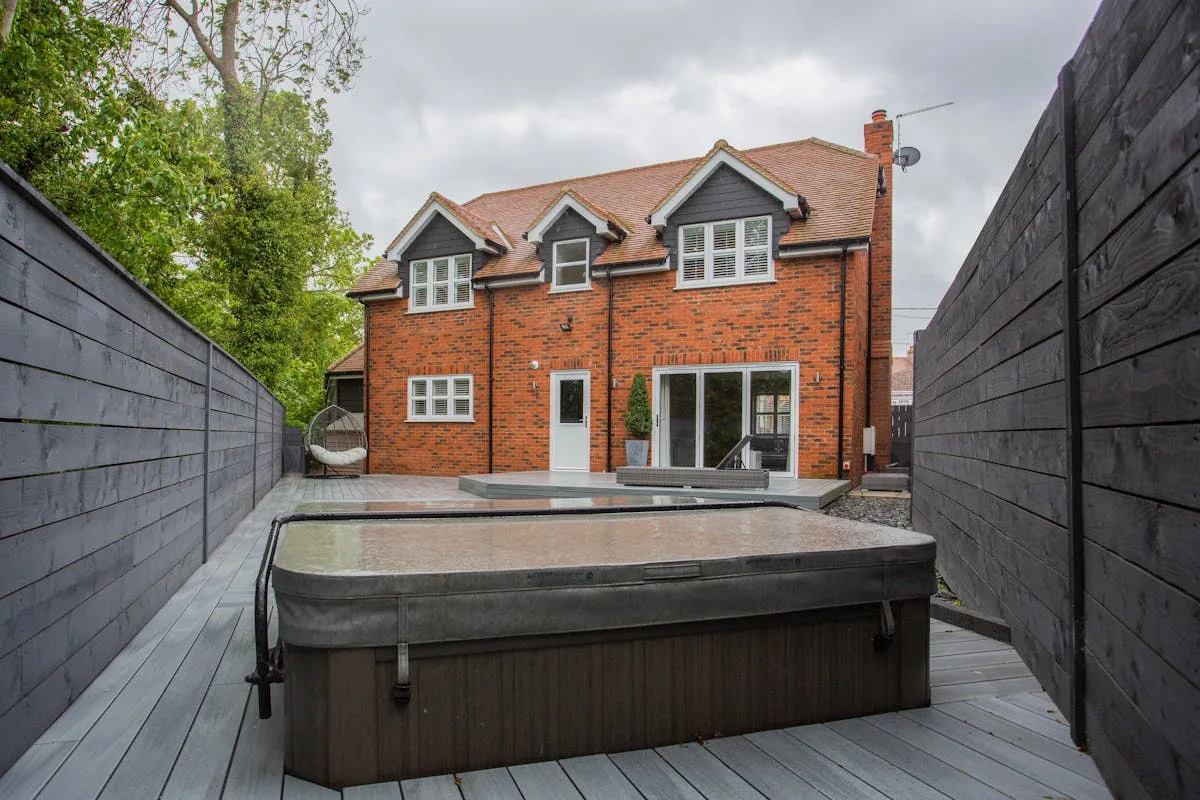
A filled 6-person hot tub weighs 1,500-2,000kg. That weight needs a solid, level surface:
- Concrete pad (150mm thick, reinforced) — the gold standard. £300-600 to have poured
- Existing patio — often fine if it’s solid concrete or properly laid flagstones. Check for dips or uneven areas
- Composite decking — must be built specifically to support the weight. Standard residential decking will collapse. Get structural advice
- Hot tub base pads — interlocking plastic tiles that distribute weight. £200-400. Good for level ground but not a substitute for a proper base on soft soil
Position Considerations
- Shelter from wind — wind strips heat from the water and cover. A fence, wall, or hedge on the prevailing wind side (typically southwest in the UK) reduces running costs
- Close to the house — shorter run in a towel, shorter electrical cable run, easier to pop out for a soak
- Away from neighbours — hot tubs are social, which means conversation and occasionally music late at night. Be considerate about placement
- Privacy — you probably don’t want your neighbour watching every soak. Screening, fencing, or strategic planting helps
- Level ground — even 2cm of slope causes uneven water levels and puts stress on the shell
- Drainage — when you drain the tub (every 3-4 months), where does 1,500 litres of chemically treated water go? Not into a neighbour’s garden, ideally
Planning Permission
Hot tubs don’t normally need planning permission in the UK, as they fall under permitted development. However, if you live in a conservation area, listed building, or planning-restricted zone, check with your local authority first. Purpose-built enclosures (gazebos, buildings) over a certain size may need permission.
Buying: Showroom vs Online
Showroom Advantages
- Wet testing — sit in a running tub before buying
- See actual build quality, finish, and jet power
- Speak to someone who knows the product
- Often includes delivery, installation, and commissioning
- Easier to negotiate on price
Online/Direct Advantages
- Lower prices (no showroom overhead)
- Wider range of brands
- Customer reviews help identify common issues
- Delivered to your door
Recommendation: Visit at least one showroom to understand what you’re looking for — jet power, seating comfort, noise levels. Then compare prices online. Many brands offer both showroom and direct purchase.
What to Ask Before Buying
- What’s the total installed cost? Include delivery, crane hire (if needed), electrical installation, and base preparation
- What’s the warranty? Shell (5-10 years), plumbing (2-5 years), equipment (2-3 years) are reasonable minimums
- Who handles warranty repairs? The dealer? A third-party service company? How quickly?
- What’s the energy consumption? Ask for the kWh rating or average monthly running cost in the UK climate
- What electrical supply does it need? 13amp, 32amp, or 40amp — and does the price include installation?
- Can you do a wet test? If a dealer won’t let you try before buying, why not?
- What’s included? Cover, cover lifter, steps, start-up chemical kit — or are these all extras?
- What filters does it use, and what do they cost? Some brands charge £50+ per filter, needed 1-2 times per year
The Bottom Line
The right hot tub for most UK families is a hard-shell, 5-6 person model with full-foam insulation, at least two pumps, adjustable water jets, and a quality cover. Budget £5,000-8,000 for the tub, £500-1,000 for installation (base + electrics), and £50-80/month for running costs.
If that’s too much right now, an inflatable Lay-Z-Spa for £400-600 lets you test whether hot tub life suits you without major financial commitment. We’ve reviewed the best inflatable hot tubs for 2026 to help you pick the right one.
Whatever you choose, buy from a brand with UK service support, check the warranty carefully, and don’t be swayed by jet counts alone. The best hot tub is the one that’s properly insulated, comfortably fits the people who’ll actually use it, and reliably works on a cold Tuesday evening in February when you need it most.
Frequently Asked Questions
How often should I test hot tub water? Test pH and sanitiser before each soak, or at least three times a week during regular use. Small hot tubs can drift quickly because the water volume is low.
What is the safest hot tub sanitiser? Chlorine and bromine are both widely used when maintained at the right level. Bromine is often gentler in hot water, while chlorine is cheaper and easier to find.
Why does hot tub water go cloudy? Cloudiness usually comes from low sanitiser, high pH, dirty filters or heavy bather load. Balance the water, clean the filter and shock the tub before using it again.
What should I check first with How to Choose a Hot Tub: The Complete Buyer’s Guide? Start with the real use case, then check size, compatibility, running costs and maintenance. A product that looks good on paper can still be the wrong fit if it does not suit the room, routine or budget.
How do I avoid wasting money on How to Choose a Hot Tub: The Complete Buyer’s Guide? Avoid buying on one headline feature alone. Compare the practical details, read the warranty or returns terms, and choose the option that solves your main problem rather than the one with the longest specification list.